The sustainability of krill is about catching it in a way that does not compromise its ecosystem and future availability. It gained attention in the mainstream media over the last decade after a few studies suggested a connection between declining Antarctic krill (Euphausia superba) biomass and its predator populations in the southern ocean.
Krill is positioned near the bottom of the marine food chain and is the primary food source for certain seabirds and mammals such as penguins, seals, whales, and albatross. Krill, a keystone in the marine ecosystem of southern oceans, fishing became a key concern in this sole commercially active Krill fishing ocean.
To understand if Antarctic krill in the southern ocean is sustainable or not, let us review how various aspects of fishing krill have evolved into its current status and are expected to shape it in the future. Research on many of these aspects is insufficient and results thus far do not align in some cases.
Krill Fishing and Management
CCAMLR manages krill fishing to ensure sustainability
In the backdrop of increasing commercial activity, the Commission for the Conservation of Antarctic Marine Living Resources (CCAMLR) was formed in 1982, with an objective of conserving Antarctic marine ecosystems, including a focus on krill. With 24 countries and the European Union as its current members, the commission manages and regulates krill fishing in the southern ocean. The following ecosystem-based approach and through scientific inputs from member countries, fisheries, and other conservation groups, it sets conservation measures and guidelines, such as on where krill fishing takes place, area-wise spread of precautionary catch limits, and scientific observation on fishing vessels.
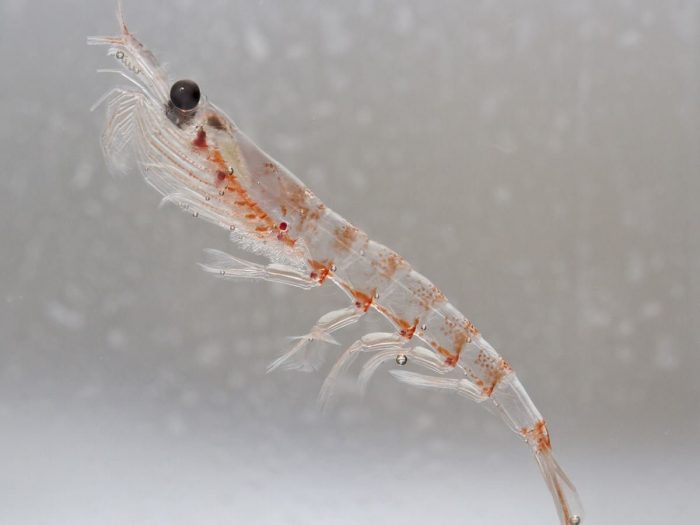
Antarctic krill is a small, swimming crustacean that lives in swarms. Photo Credit: Shutterstock
There has been no accurate estimate of krill biomass so far
Due to a lack of adequate research, the scientific community is quite far from an accurate estimate that has historically ranged from double digits to over thousand in million tonnes. With newer methods and techniques, the recent estimates have at least become finer as the estimate range is narrower than predicted by many over last three decades.
As per CCAMLR, the current krill biomass in the key fishing area in southwest Atlantic waters is estimated to be about 60.3 million tonnes. According to a study in 2009, krill biomass, extrapolated from a CCAMLR acoustic-survey in 2000, was about 133 million tonnes in 2000. Another method in this study indicates the number to be 117-379 million tonnes during 1926-2004. Together with another study by a similar team, a decline in krill biomass was suggested by about 40-80% in the last three decades. They are broadly agreeing in terms of the reduction in biomass, but the scientific community at large appears to be uncertain about the extent.
Several country-level research agencies are collecting time series annual data, which may contribute to CCAMLR in the near future.
Krill fishing area is more limited than before
At present, commercial krill fishing takes place only in three main fishing areas in southwest Atlantic waters of the southern ocean, namely, the South Shetland Islands, the South Orkney Islands, and South Georgia. Krill fishing areas appear to have shrunk from the 1970s and 1980s when it included parts of the south Indian Ocean and Pacific waters. Limited exploratory fishing is allowed in pacific and southeast Atlantic waters.
In the northern hemisphere, krill fishing is banned or highly controlled due to environmental concerns and competition with other fisheries. There is limited activity in waters around Japan and it is also minimal in areas near British Columbia. Citing ecosystem concerns, the National Oceanic and Atmospheric Association (NOAA) of the US has banned fishing krill off the coasts of California, Oregon, and Washington.
Krill Catch and Demand
Total krill catch has increased in recent years
With a krill catch of about 210,000 tonnes in 2010, there was a substantial increase from an average annual catch of 120,000 tonnes for last 17 years after 1992. For the first time, fishing was stopped in a sub-area, as it reached its trigger level limit set by CCAMLR. In 2011 and 2012, total krill catch was 180,000 tonnes and 157,000 tonnes, respectively.
Total krill catch in the future is expected to grow to 620,000 tonnes, the trigger level for the southwest Atlantic with support from vessels having high capacity and better processing technology, expanding fishing season, and increasing demand across the globe. The yearly notifications received by CCAMLR from member countries reflect their interest to catch much more than what is being caught now.
Historically, the peak krill catch from over 500,000 tonnes in the early 1980s decreased to lie between 300,000 and 400,000 tonnes during 1986-1992. It dropped further as soon as former Soviet Union discontinued its operations.
Annual krill catch is a fraction of the precautionary catch limit
Based on a revised krill biomass CCAMLR survey of 2000, the current precautionary catch limit for the main commercial fishing areas in the southwest Atlantic is 5.61 million tonnes, which is about 9.3% of the estimated biomass for the area. With catch limits not being divided into small-scale management units (SSMUs), a trigger level of 620,000 tonnes is set for this area in the last few years. Clearly, even the maximum annual catch of 210,000 tonnes in 2010 is just 34% of the trigger level and a mere 3.7% of the precautionary catch limit.
It is observed across studies that setting location-specific catch limits, where predator populations are dependent and forage for krill would be most useful in limiting over-fishing and competition between fisheries and predators.
New countries with high demand have started fishing Krill
Russia began krill fishing in 2003 and Norway began in 2005, while China and Chile started fishing in the last couple years. USA entered into fishing krill at the beginning of this century, but discontinued it by 2005.
Between 2006 and 2011, Norway and South Korea, followed by Japan, were the three main krill fishing countries responsible for about 90% of krill catch in 2011. Norway alone took over 55% of the annual krill catch in 2010 and 2011. Poland and the Ukraine were other prominent krill catching countries over the last decade. The Soviet Union led the way before 1992, while Japan led the krill catches between 1993 and 2003.
Traditionally, krill is a part of the human diet in Russia and Japan, while China has the biggest aquaculture practice.
High-capacity fishing vessels are replacing traditional vessels
Traditional fishing vessels have a catch capacity of about 100 tonnes of krill per day per vessel. With the introduction of a new vessel in 2007 by a Norwegian company, the potential krill catching-capacity of a vessel has increased up to 800 tonnes per day. The so called ‘Eco-Harvesting’ technology leads to the continuous drawing of krill, simultaneous processing, minimal by catch, and higher green weight, meaning the live krill catch brought on board for processing. In present times, out of about 10 fishing vessels stationed at select locations basedpon krill concentration, two are eco-harvesting vessels that may operate at maximum capacity.
Demand for krill products is expected to inflate in the near future
Increasing decline in global fish reserves, the on-going search for a higher nutritive food source and the decreasing gap between the cost of grains and marine foods are expected to inflate the future demand for krill.
About 88% of the krill catch is used in aquaculture and as bait in sport fishing, whereas only a small part of the remaining 12% is used for human consumption used in krill oil supplements. There has been the recent entry of China, with the biggest aquaculture practice is likely to contribute majorly to the anticipated increase in demand.
Within the omega-3 fatty acid market, krill oil supplements grew by about 70% in the US compared to about 5% growth of fish oil supplements in 2011. With a 4% share in the overall omega-3 ingredients, it will likely grow steeply to overtake flaxseed and other omega-3 sources. High growth in Europe, coupled with newer markets in Australia and Asia, will further add to pressure on krill supplies.
Climate and the Krill Ecosystem
Decreasing winter sea ice likely reduces krill and predator populations
The western Antarctic Peninsula has warmed up more rapidly than anywhere else. With about 5-6 degree Celsius increase in mean winter air temperature over the last 60 years, a decline in winter sea ice around the Antarctic Peninsula and the Scotia Sea has been observed. The effect of sea ice on marine ecosystem and its connection with krill and predator populations is yet to be completely understood by scientists.
It is believed that decreased winter sea ice causes a reduction in krill food and habitat, as the larvae and juvenile krill thrive on the algae under the sea ice cover, while mature krill find a refuge from certain predators, such as whales and fish under the sea ice.
Several studies have suggested a relationship between krill and its predator populations. There is about a 50% decline observed in both Adelie (ice-loving) and Chinstrap (ice-avoiding) species of penguins around a major fishing location in the last three decades. This is believed to be due to the shortage of krill food mediated by less sea ice cover.
The decline in winter sea ice also affects the krill population directly by increasing access to otherwise difficult waters. In recent years, fishing season has expanded until mid-winter.
As per a recent study in October of 2012, a slight expansion in overall Antarctic sea ice has been observed in the last two decades due to wind drifts. There are several individual regions of loss and gain in sea ice based upon local wind conditions and direction. It appears that in areas around the Antarctic Peninsula, the drift of ice is towards the land of the Antarctic continent, perhaps a cause of the observed depletion in sea ice.
How recovery of whales and fur seals is linked to krill stock is unclear?
As per certain studies, due to the predator-prey relationships, recovery in population of whales and fur seals after 1970 is contributing to the believed decline in krill biomass. Excess hunting of these for about a century was linked to high stocks of krill during that time.
A contrary point of view indicates that krill maintain the iron cycle of the ocean, thereby more krill would lead to more whales and the other way around, as iron-rich whale excreta contribute to increased small plant growth, which is a food for krill.
Ocean acidification may inhibit krill growth in distant future
Studies suggest that embryos and larvae of Antarctic krill fail to survive if there are high levels of carbon dioxide (CO2) in water. The cold waters of the southern ocean absorb more CO2 than any other ocean and by the year 2100, are expected to have levels that could significantly harm krill growth. The upwelling of deep waters high in CO2, typical of southern ocean waters, further increases the risk of ocean acidification for krill and marine ecosystems. More studies are suggested to observe adult stages of krill.
Industry Reaction to Krill Sustainability
Sustainability concern is more a perception than a reality
Krill fisheries consider the sustainability concern to be more of a negative perception than a reality and have been continuously clarifying that through various marketing messages in the mainstream media.
There are limited examples of big fisheries obtaining certifications that approve sustainable krill fishing practices from third party organizations or engaging into research support with CCAMLR and other conservation bodies. Most of these developments have been controversial and criticized by some on grounds such as giving false impressions on sustainability and conflicts of interest.
On the other hand, the manufacturers are getting ready to meet the growing demand and are involved in increasing processing capacity, patent and product approvals in various countries, and partnering to expand into newer markets across the globe. Also, as per a recent study, krill fishing activity of the biggest fishery during fishing season in 2007-11 overlapped with the summer foraging areas of penguins and fur seals by a low-high extent.
So, Finally…Is Krill Sustainable?
Recent CCAMLR measures are in line, but may not be swift enough
Initiatives by CCAMLR in the last few years to regulate and manage krill fishing are moving in the right direction, but may lag behind the expected near-future inflating demand. Possible causes include the slow pace of the scientific research, limited support from member countries on issues involving negotiations, and the acceptance of certain guidelines.
Current active themes include increasing scientific observation on krill fishing vessels, exploratory fishing areas as a focus of research; newer methods to assess live catch i.e. green weight, real-time krill catch data for the development of feedback management system, and a discussion on establishing marine protection areas (MPAs).
The overarching ecosystem-based approach followed by CCAMLR is in line with the beliefs of the entire scientific community.
As of now, krill is probably sustainable, but more caution is required in future
As evident from scientific studies, krill fishing is not solely responsible for the declining krill biomass, while depleting sea ice cover appears to have a greater negative effect on krill stocks and changes in the ecosystem, such as predator populations.
So far, the annual krill catch is well within limits, and is believed to be ‘probably sustainable’ by many and ‘under exploited’ by few. However, it is expected to catch up with the precautionary limits in the near future, most likely due to the introduction of high-capacity vessels with better processing technology, more countries entering into the krill fishing, expanding fishing seasons due to depleting winter sea ice, perceived higher nutritive value of krill than fish, newer consumer markets across the globe, and aggressive expansion plans by krill producers.
Until accurate estimates of krill biomass, and conclusive understanding on how krill is affected by changes in climate, ecosystem, and predator populations, CCAMLR needs to exercise caution in managing krill fisheries to ensure sustainability of krill and marine ecosystem.
Things to do, until long-term krill sustainability is ensured
By CCAMLR
Conduct and facilitate research with member countries and conservation bodies:
Accurate estimate of krill biomass
Effect of change in climate and environment on sea-ice
Connection between sea-ice cover, krill, and predator populations
Spatial and temporal distribution of krill
Effect of hunting and recovery of whale, fur seals, and other predators on krill population
Ocean acidification and its potential long-term risks to various stages of krill growth
Appropriate methods to calculate green weight of krill
Role of krill in maintaining ‘Iron cycle’ of the southern ocean
Until final understanding is developed, exercise caution in:
Setting up precautionary catch and trigger levels in fishing area, sub-area, and SSMUs
Allowing krill fishing at local places where predator populations forage
Guidelines related to scientific observation on fishing vessels
Fishing in exploratory areas, where precautionary limits are not yet defined
By Fisheries
Increase utilization of fishing vessels to assist data collection such as on krill and predators, by catch
Avoid over-fishing in areas where predators, such as penguin, are exclusively dependent on Krill
Responsibly use latest high-capacity fishing vessels
Ensure transparency in data communication to CCAMLR
Support and allow scientific observation
By People
Limit use of krill meals in aquaculture and aquariums
Substitute krill as a bait in sport fishing
Re-evaluate the need for using krill oil dietary supplements
Limit or avoid farm fish, such as salmon, that is raised on krill meals
Carefully select products with relevant certifications
Sources
AkerBioMarine, Mapping krill trawling and predator distribution
Antarctic and Sothern Ocean Coalition, The big picture-Broad-scale study suggests sea ice not driving changes in penguin populations, Krill-conservation
Australian Antarctic Division, Krill face deadly cost of ocean acidification
British Antarctic Survey, Sustainability of Antarctic krill, Antarctic krill help to fertilise southern ocean with iron, Press Release – Why Antarctic sea ice cover has increased under the effects of climate change
CCAMLR, CCAMLR, Statistical-bulletin, Report of Scientific Committee
GLOBEC, Can the ecology of krill be described simply?
Inter-Research Science Center, Impact of climate change on Antarctic krill
Krillfacts.Org, The fishery for Antarctic krill – recent developments
Natural Products Insider, The krill choice, Krill harvests decreased in 2012, Stephen Nicol talks krill sustainability
Nature Geoscience, Wind-driven trends in Antarctic sea-ice drift
Nature, Long-term decline in krill stock and increase in salps within the Southern Ocean, Ecologists fear Antarctic krill crisis
Nutraingredients, Krill catch is probably sustainable-Antarctic researcher, WWF backs krill fishery as new data and better harvest methods surface, WWF on krill: “World’s largest under-exploited fishery”, Antarctic krill harvest under scrutiny after penguin study
NYTimes, Team tracks a food supply at the end of the world, Overfishing of krill threatens ocean ecosystem
Pew Environment Group, Antarctic krill conservation project
Proceedings of the National Academy of Sciences, Variability in krill biomass links harvesting and climate warming to penguin population changes in Antarctica
Science Daily, NOAA bans commercial harvesting of krill
Science Direct, A re-appraisal of the total biomass and annual production of Antarctic krill
SFCC-NOAA, The risks of not deciding to allocate the precautionary krill catch limit among SSMUS and allowing uncontrolled expansion of the krill fishery up to the trigger level [1] [2] [3] [4] [5] [6] [7] [8] [9] [10] [11] [12] [13] [14] [15] [16] [17] [18] [19] [20] [21] [22] [23] [24] [25] [26] [27] [28] [29] [30] [31]
– Amit Khurana
Amit is a health enthusiast and believes in the importance of ‘what we eat’ in maintaining it. He is an avid writer focusing on research-based facts and opinions on food and nutrients. He likes to provide contrary perspectives to well inform his readers and continues to explore the difference in beliefs on health and food in the eastern and western part of the world. Amit is an occupational therapist and has worked in clinical settings of rehabilitation. He has extensive experience in researching and writing on scientific and commercial aspects of diseases, treatment, diagnostics, devices, and services in healthcare.