Treatments and home remedies for constipation include the use of laxatives, biofeedback therapy, triphala, and an adequate intake of water. It is encouraged that one’s diet is consistent with fiber-rich fruits and vegetables, whole grain products, figs or anjeer, castor oil, flax seed. Partaking in regular exercise or walking is also encouraged versus being sedentary throughout the day. The primary causes of constipation usually include dehydration, an improper diet, certain medications, medical conditions, and stress.
According to the National Institute of Diabetes and Digestive and Kidney Diseases, constipation is a digestive disorder when your stool becomes hardened or bowel movements happen fewer times per week than normal. Specifically, having less than 3 bowel movements per week is considered outside the normal range. A sense of an incomplete bowel movement or pain due to straining is also a sign of being constipated. The cause of this condition is the stiffening of stool near the rectum, obstructing the smooth passage of stool. [1] [2] [3] [4] [5]
Treatments for Constipation
There are many treatments available for constipation that can range from medical and Ayurvedic to home remedies. Let us discuss these in detail below.
Medical Treatments
If certain dietary and lifestyle changes don’t improve your condition, then you need to go for treatment. According to research by Dr. Louis Wing Cheong Liu, University of Toronto some of the treatments for chronic constipation include the following: [6]
- Laxatives – bulk-forming agent, stool softeners, osmotic agents, stimulants and lubricants
- Lactulose
- Prescribed medications – lubiprostone and linaclotide
- Biofeedback theory or mind-body technique
- Over the counter medicines
- Surgery – In case of anorectal blockage or obstruction, your doctor may recommend surgery
While using the laxatives, you need to know the side effects as sometimes they can do more harm than good and worsen the medical condition. Also, make sure to consult your doctor before trying any treatment.
Ayurvedic Treatments
To help improve constipation, Ayurveda suggests drinking a lot of water throughout the day, and if possible increasing the intake of herbal tea and organic oils like ghee and olive oil. It also suggests adding fibrous and hydrating fruits like bananas, apples, and prunes in your diet. According to a research study by Christine Tara Peterson PhD (Department of Family Medicine and Public Health, UC San Diego School of Medicine, Center of Excellence for Research and Training in Integrative Health), Kate Denniston, BS, and Deepak Chopra, MD, Triphala is rich in antioxidant properties and helps in treating constipation. [7]
How to use: You can easily find Triphala tablets or trifala powder and consume it. However, it is recommended to consult a doctor before trying any natural remedy or herb.
Home Remedies for Constipation
Constipation can be improved by following certain home remedies and self-care methods that are very easy to implement. According to NIH diet and nutrition play a key role in treating constipation. [8] [9]
With the implementation of these home remedies for constipation, one can experience free and smooth bowel movements, without the need to apply pressure. Home remedies also help to fade away any feelings of an incomplete bowel movement.

Treatment for chronic constipation begins with changes in diet and lifestyle. Photo Credit: Shutterstock
Fiber Intake
A study by J. H. Cummings, Emeritus Professor of Experimental Gastroenterology in the University of Dundee suggests that dietary fiber plays an important role in providing relief from constipation. People whose diet consists of less fiber or no fiber at all are more prone to problems of constipation. According to dietary guidelines released by the U.S. Department of Agriculture and U.S. Department of Health and Human Services, an older adult (at least age 51) should consume 25-31 g of fiber on a daily basis. For young adults below the age of 50, it is recommended to consume 25 grams for women and 38 grams for men each day. [10] [11]
The best source of dietary fiber is through the intake of vegetarian food. Good sources of dietary fiber include the following (Source: National Institute of Diabetes and Digestive and Kidney Diseases): [12]
- Whole grains such as whole wheat and whole rice
- Vegetables such as carrots and broccoli
- Legumes such as soybeans and black beans
- Fruits like apples, berries, and oranges
- Nuts like almonds and pecans
Soluble fiber is the undigested food that soaks up water in the process of digestion. When moving into the colon, undigested fiber is converted into a stool. As it contains more water, the stool then easily moves through the colon and out of the body.
Insoluble fiber increases stool bulk and promotes the movement of stool through the body. It does not soak up water like soluble fiber which is beneficial for those who retain water and bloat easily. [13]
Water
Water, as already mentioned, is one of the major components of our body that helps in most metabolic activities, especially digestion. Drinking the recommended amount of water every day (at least 6 to 8 glasses) will help not only in maintaining an optimum water level in the body but will also help promote bowel movements. As per a recent study conducted by Gordana Bothe et al. and published in the European Journal of Nutrition, mineral water rich in sulfate and magnesium helps relieve symptoms of constipation. Further, research on diets for constipation by Dr. Sun Hwan Bae, Department of Pediatrics, Konkuk University School of Medicine, Seoul, Korea indicates that sufficient fluid intake does help in treating constipation. [14] [15]
It is suggested that people who suffer from constipation must drink at least one liter of water early in the morning (not bottoms up, but gradually) and then have a vigorous walk of at least 10 minutes. As the water gets processed through the digestive system, it will wash away any undigested food in the stomach and small intestines, moving it into the large intestine. Here, the rushing water dilutes the hard stool and makes it softer and easier to move. The water in your stomach also puts pressure on the lower part of the digestive system.
Fruits
Fruits are highly recommended for controlling constipation. Fruits contain dietary fiber that helps to treat constipation. There are many varieties of fruits and vegetables that can be consumed on a daily basis to avoid constipation. Further, the latest research by Dr. Sun Hwan Bae suggests that intake of fruits aids in treating constipation. Some of the best fruits include the following: [16]
Dr. Aase Wisten and Dr. Messner T. (Department of Internal Medicine, Sunderby Hospital, Luleå, Sweden) in their research found that fiber-rich porridge is an effective way to treat constipation, especially in geriatric patients. Other fruits such as apples, papayas, oranges, apricots, guavas, strawberries, dates, raisins, and pears have all been associated with reduced constipation. [17]
Vegetables
Intake of vegetables rich in fiber also helps in providing relief from constipation. The best vegetables rich in good fiber that may help clean out bowels include the following:
- Cabbages
- Carrots
- Broccoli
- Cauliflower
- Asparagus
- Potatoes with skin
- Spinach
- All types of gourds such as bottle gourd, snake gourd, bitter gourd, and ridged gourd
The best way to consume them is by consuming them half-cooked or raw.
Whole Grain Products
Whole grains are a good source fiber and consuming whole grain products such as whole wheat, whole or brown rice, is recommended if suffering from constipation. Intake of polished grain products like white rice and polished wheat flour should be avoided. [18]
Whole grains also contain other nutrients such as essential B complex vitamins that further strengthen the health of the digestive system. Polished grain lacks this type of fiber.
Figs
Research conducted by Hong-Geun Oh et al. Huvet Co., Ltd, Iksan, Korea suggests that figs are one of the laxative foods that help in relieving constipation. According to a study by Lee HY et al. (Food and Chemical Toxicology (FCT) journal), the intake of fiber promotes smooth digestion and helps in producing bulky stools that are easier to pass. [19] [20]
Psyllium
Psyllium seeds or ispaghula has large amounts of dietary fiber. Research published in Alimentary Pharmacology & Therapeutics Journal by Dr. J W McRorie et al. suggests that fiber inside psyllium is ideally suited for constipation. This is because it is not absorbed by the small intestine and on its way to the colon, it absorbs a lot of water and pushes out stool, thereby relieving you of constipation. [21]
Flaxseed
Flaxseed has specifically been used for treating constipation as it is rich in soluble fiber. A four-week trial research study by Basch E et al. Memorial Sloan-Kettering Cancer Center, New York, NY, the USA on healthy people with flax seed intake found that their bowel movements increased by about one-third. Research has also shown that the use of flaxseed in patients suffering from constipation with irritable bowel syndrome (IBS-C) showed a significant improvement in their condition with a reduction in constipation and pain. [22]
Castor Oil
Castor oil has been traditionally used as a laxative. It is a stimulant laxative that stimulates not only the large intestine, but also small intestine, and it helps in washing away fecal matter. Research conducted by T. S. Gaginella and S. F. Phillips (published in The American Journal of Digestive Diseases) suggests that castor oil prevents water absorption in the intestine, thus making feces softer and easier to move. [23] [24]
Almond Oil
Consume milk with 2 tablespoons of almond oil added to it every night. Consume this mixture for 3-4 days to help rid yourself of constipation.
Dates
Make a paste from a half cup of dates. Mix this paste with milk and consume it every night before going to sleep. Dates can also be consumed in raw form with the pit removed. The fiber in dates will reduce constipation.
Bishop’s Seed
Bishop’s seed or ajowan has been traditionally used in India to treat constipation. A spoonful of ajowan seeds mixed with lukewarm water helps relieve constipation.
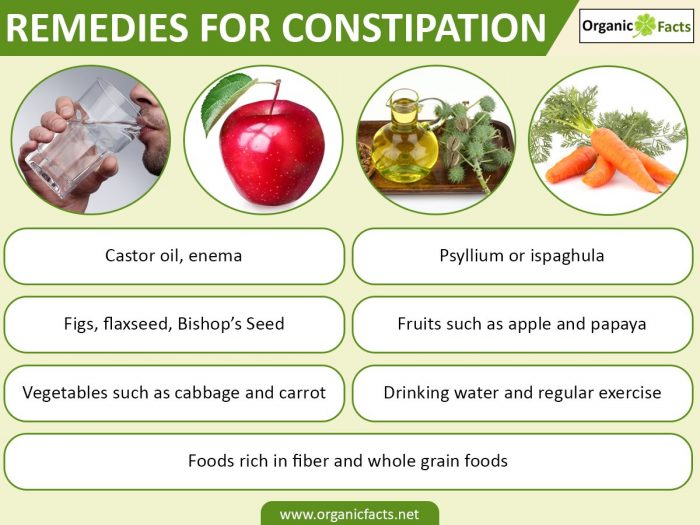
An infographic showing various foods that will help you treat constipation Photo Credit: Shutterstock
Regular Exercise
Regular exercise is an effective remedy for constipation. Exercising regularly not only stimulates the external muscles but also the muscles in internal organs to expand and contract. This is especially true in the case of the digestive system, which moves food through peristaltic movements.
Yoga for constipation
Yoga can be another good choice to deal with constipation. There are exercises that specifically deal with constipation. These include Surya Namaskara, Pavanamukta Asana, Trikona Asana, Hala Asana, Tada Asana, Matsya Asana, and Ardha Matsyendra Asana.
Enema
An enema is another approach to treating constipation. It is useful when water intake does not yield the expected result. Administering a plain enema with or without any medication helps in constipation by loosening hard stool.