The amazing health benefits of eggs include their ability to balance nutrient intake in the body, lower “bad” cholesterol levels, increase cognitive function, protect the heart, prevent eye disease, detoxify the body, help you lose weight, and guarantee proper growth and development.
Eggs as Food
Eggs are some of the fascinating parts of our diet, simply because they themselves are so unique. Eggs are reproductive shells laid by females of numerous species, including fish, reptiles, and, in terms of human nutrition, birds. While fish eggs are also eaten in a number of cultural dishes and national cuisines, bird eggs are the most commonly consumed variety of eggs by humans, and out of bird eggs, chicken eggs are by and large the most popular. Eggs have been a part of the human diet for thousands of years, as they were discovered early on in our cultural development as a safe and beneficial form of food that could be acquired and cultivated along with the second form of food – chicken. [1]
Eggs have become a staple part of diets across the world, as they are not only a food source in and of themselves, but they also function in the creation of hundreds of other meals and ingredients necessary for cooking a limitless range of food. The list of foods in which eggs can be found would be an article all by itself, but suffice to say that they constitute an essential part of the human diet for a number of reasons, and should definitely be considered when trying to eat right. [2]

Eggs contain essential nutrients that help support body function and development. Photo Credit: Shutterstock
Eggs are so widely loved and used because they provide a powerhouse of nutrients inside their tiny package. There are enough nutrients in an egg to develop a single cell into a baby chick, and we need many of those same nutrients!
Serving Size : Nutrient Value Water [g] 76.15 Energy 143 Energy [kJ] 599 Protein [g] 12.56 Total lipid (fat) [g] 9.51 Ash [g] 1.06 Carbohydrate, by difference [g] 0.72 Sugars, total including NLEA [g] 0.37 Glucose (dextrose) [g] 0.37 Calcium, Ca [mg] 56 Iron, Fe [mg] 1.75 Magnesium, Mg [mg] 12 Phosphorus, P [mg] 198 Potassium, K [mg] 138 Sodium, Na [mg] 142 Zinc, Zn [mg] 1.29 Copper, Cu [mg] 0.07 Manganese, Mn [mg] 0.03 Selenium, Se [µg] 30.7 Fluoride, F [µg] 1.1 Thiamin [mg] 0.04 Riboflavin [mg] 0.46 Niacin [mg] 0.08 Pantothenic acid [mg] 1.53 Vitamin B-6 [mg] 0.17 Folate, total [µg] 47 Folate, food [µg] 47 Folate, DFE [µg] 47 Choline, total [mg] 293.8 Betaine [mg] 0.3 Vitamin B-12 [µg] 0.89 Vitamin A, RAE [µg] 160 Retinol [µg] 160 Cryptoxanthin, beta [µg] 9 Vitamin A, IU [IU] 540 Lutein + zeaxanthin [µg] 503 Vitamin E (alpha-tocopherol) [mg] 1.05 Tocopherol, beta [mg] 0.01 Tocopherol, gamma [mg] 0.5 Tocopherol, delta [mg] 0.06 Tocotrienol, alpha [mg] 0.06 Tocotrienol, gamma [mg] 0.01 Vitamin D (D2 + D3), International Units [IU] 82 Vitamin D (D2 + D3) [µg] 2 Vitamin D3 (cholecalciferol) [µg] 2 Vitamin K (phylloquinone) [µg] 0.3 Vitamin K (Dihydrophylloquinone) [µg] 0.1 Fatty acids, total saturated [g] 3.13 4:0 [g] 0 8:0 [g] 0 10:0 [g] 0.01 14:0 [g] 0.03 15:0 [g] 0.01 16:0 [g] 2.23 17:0 [g] 0.02 18:0 [g] 0.81 20:0 [g] 0 22:0 [g] 0 Fatty acids, total monounsaturated [g] 3.66 14:1 [g] 0.01 16:1 [g] 0.2 16:1 c [g] 0.2 17:1 [g] 0.01 18:1 [g] 3.41 18:1 c [g] 3.39 20:1 [g] 0.03 Fatty acids, total polyunsaturated [g] 1.91 18:2 [g] 1.56 18:2 n-6 c,c [g] 1.53 18:2 CLAs [g] 0.01 18:3 [g] 0.05 18:3 n-3 c,c,c (ALA) [g] 0.04 18:3 n-6 c,c,c [g] 0.01 20:2 n-6 c,c [g] 0.02 20:3 [g] 0.02 20:3 n-3 [g] 0 20:3 n-6 [g] 0.02 20:4 [g] 0.19 22:4 [g] 0.01 22:5 n-3 (DPA) [g] 0.01 22:6 n-3 (DHA) [g] 0.06 Fatty acids, total trans [g] 0.04 Fatty acids, total trans-monoenoic [g] 0.03 16:1 t [g] 0 18:1 t [g] 0.02 18:2 t not further defined [g] 0.01 Fatty acids, total trans-polyenoic [g] 0.01 Cholesterol [mg] 372 Tryptophan [g] 0.17 Threonine [g] 0.56 Isoleucine [g] 0.67 Leucine [g] 1.09 Lysine [g] 0.91 Methionine [g] 0.38 Cystine [g] 0.27 Phenylalanine [g] 0.68 Tyrosine [g] 0.5 Valine [g] 0.86 Arginine [g] 0.82 Histidine [g] 0.31 Alanine [g] 0.74 Aspartic acid [g] 1.33 Glutamic acid [g] 1.67 Glycine [g] 0.43 Proline [g] 0.51 Serine [g] 0.97 Sources include : USDA [3]
Egg Nutrition
According to USDA, a 1 large hard-boiled egg (50 g) provides energy (77.5 Kcal), protein (6.29 g), fat (5.3 g), cholesterol (186 mg). It contains vitamins such as cobalamin, vitamin D, A, and vitamin B-6. Amongst minerals, it provides calcium, phosphorus, potassium, iron, and sodium. [4]
There are two essential parts of an egg; the albumen (the white part) and the yolk (the yellow part). The yolk is suspended in the albumin and contains about 80% of the calories and almost all the fats present in the egg. It contains many vitamins and minerals as well. The egg albumen mostly contains water and proteins.
Calories in an Egg
The calorie count in an egg depends on the way it is prepared. Let us look at the calories for different egg preparations (Source: USDA) [5]
- A large raw egg contains about 72 calories
- 1 large boiled egg contains about 78 calories
- 1 large fried egg contains about 90 calories
- 1 omelet made from a large egg contains approximately 94 calories
- 1 large poached egg contains about 71 calories
Health Benefits of Eggs
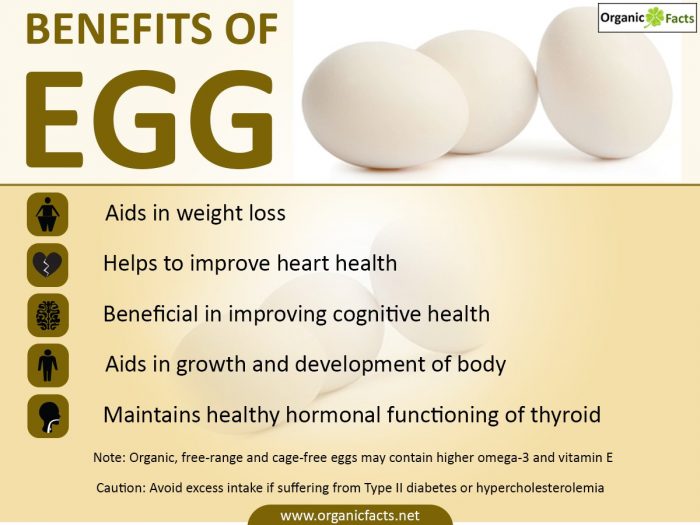
The most common benefits of eggs include their ability to help in growth and development, aid in weight loss, improve heart health, and many more. Let’s have a look at the benefits in detail.
Growth and Development
There is a reason why eggs are such an important food staple in our formative years; it seems like breakfast almost always contained an egg while we were young! The high concentration of protein, as well as other essential vitamins, means that our bodies can develop at a normal rate and get all of the necessary nutrients to grow properly and set young people on a trajectory for lifelong health. Protein is necessary for cell creation, which means that every part of our body, every organ, hair, blood vessel, and bone in some way relies on protein to exist. [6]
Heart Health
While there has been significant criticism in recent decades about the potential dangers of eggs on heart health, due to its admittedly high content of cholesterol, many people don’t look at the type of cholesterol, nor its effect on the body. Most studies have actually shown them to protect against strokes and improve heart health, as the “good cholesterol” (HDL cholesterol) levels increase, which can help to eliminate “bad cholesterol” in the body. By lowering LDL cholesterol levels, they help to avoid atherosclerosis, blood clots, strokes, heart attacks, and other serious cardiovascular conditions! [7]
Weight Loss
Since eggs are so full of those important proteins that our body needs for development, they also tend to be a very satisfying and filling form of food. They provide energy and nutrient stability in our body and satisfies our hunger. They can be a great way to get the healthy balance you need without consuming excess calories, which is a great way to lose weight or keep your weight down. [8]
Cognitive Ability
One of the lesser-known benefits of eggs is its impact on cognitive health, primarily due to the high levels of choline present. Choline is often grouped with B-vitamins, but in fact, it is a somewhat unknown nutrient that helps to create critical neural pathways in the brain. About 90% of the population is estimated to get less choline than the body requires, but whole eggs supply choline in large quantities! [9]
Antioxidant Activity
Eggs provide valuable nutrients as part of a balanced diet. Photo Credit: Shutterstock
It seems as though any food with antioxidant capacity is considered healthy, but many people forget that eggs contain various antioxidants, including vitamin A, lutein, and zeaxanthin. Vitamin A works as an antioxidant in a number of areas in the body but works particularly well with lutein and zeaxanthin in the eyes to protect against macular degeneration and the development of cataracts. Antioxidants are able to seek out free radicals and neutralize those dangerous particles (formed as byproducts of cellular metabolism) before they can cause oxidative stress on body organs, resulting in chronic diseases, such as cancer and heart disease. [10]
Rare Minerals
The mineral composition of eggs is wonderful, but it is also unique, in that it can be difficult to obtain certain minerals, like iodine, and selenium, in our diets. They are so versatile and universal that we can almost unconsciously stay balanced by eating them, ensuring that those rare minerals keep our antioxidant activity up (selenium), and maintain healthy hormonal functioning in our thyroid (iodine). [11]
Importance of Cage-free & Free-range Eggs
All of these important health benefits are derived, in part, from the condition in which the hen was raised. The diet that the mother hen has will obviously be reflected in the nutrient content of the egg. For that reason, it is a far better choice to consume pasture-fed eggs, as they have consistently been shown to have higher omega-3 content, vitamin E content, tend to be larger, and are more densely packed with nutrients. [12]
While the price tag might be slightly higher for organic, free-range, or cage-free eggs if you are serious about getting the most health benefits out of them that you can dig a bit deeper in your pockets.
Word of Warning
While eggs are obviously major sources of nutrients for the human population, there is a high level of cholesterol in them, which may be dangerous for people suffering from hypercholesterolemia. A 2019 study published in the Journal of the American Medical Association linked higher consumption of eggs was significantly linked with a higher risk of cardiovascular disease. Furthermore, some studies have shown an increase in negative effects between people with Type II diabetes and excessive egg consumption, but a further study on that point still needs to be conducted. [13] [14]