Think of a fiber that is non-allergenic, comforting, 100% plant-derived, soothing, has high absorbent properties, is a non-irritant, and has wide medical and industrial uses. Apart from being the top natural fiber in terms of its uses in cloth manufacturing. I am sure that the only name that will come to your mind is “cotton”. To be more precise, that is probably conventionally grown cotton, which is the most infamous of crops in terms of the usage of chemical pesticides and fertilizers in its cultivation.
It has an enormous appetite for these toxic pesticides and fertilizers and is alone responsible for the consumption of more than 15% of the world’s total production of pesticides. However, despite being so infamous, if conventionally grown cotton is so widely sought after and is still so soothing on skin, then think how soothing and comfortable Organic Cotton can be. The way Organic Cotton is becoming famous and its production is increasing, you must have heard its name by now. Many of you might know it very well by now. For those who have just heard the name and want to know more or for those who have not heard of it yet, the following article should be very enlightening.
What is Organic Cotton?
Organic Cotton is cotton that is grown without using any chemical fertilizers or pesticides on it. It is grown on land that has been treated and given sufficient time (at least three years) for the removal of all the toxic residues of chemical fertilizers and pesticides used earlier on it. The cotton is from original plants, meaning plants that are not genetically modified and that have not been treated with any chemicals (washes, bleaches, colors, or scents) during its processing and packaging. [1]
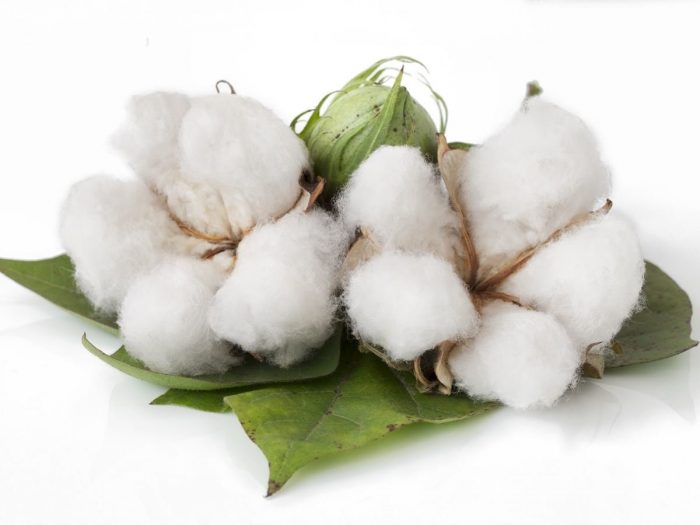
Organic cotton is grown using methods and materials that have a low impact on the environment. Photo Credit: Shutterstock
Production
The production of Organic Cotton has increased enormously over the last few years. Global Organic Cotton production jumped by more than 53% in 2006-2007 over that in 2005-2006, and then amazingly by almost 152% in 2007-2008. That amounts to 145,872 Metric Tons or 668,581 Bales grown in 24 countries, with India topping all other nations.
Among others, the specialty of Indian Organic Cotton is that all the cotton is hand-picked. The major Organic Cotton producing nations include India, Syria, Turkey, China, Tanzania, United States of America, Uganda, Peru, Egypt, Burkina Faso, West Africa and Kyrgyzstan.
Uses of Organic Cotton
Organic Cotton can rightly be called the most skin-friendly, most soothing, and most harmless natural fiber. While conventional cotton can sometimes be irritating to newborn skins, Organic Cotton is never like that. It is the ideal material for protecting and cleaning newborn babies, particularly for making clothes, bandages, covering and cleaning wounds, baby crib beddings, baby clothes, towels, and thousands of such things. It can also be safely used in surgeries where contamination from any source can be fatal. Organic Cotton Seed Oil, a byproduct of Organic Cotton, has wide uses in snacks and in feed for livestock.
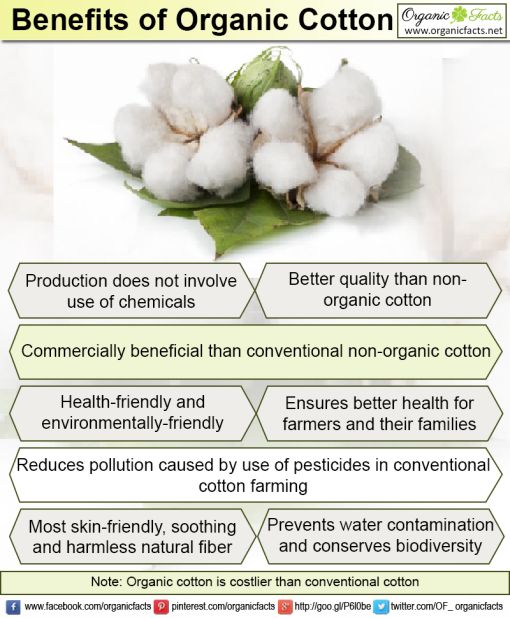
Organic cotton comes from plants that have not been genetically modified. Photo Credit: Shutterstock
Market
You can have a very good idea of the market for Organic Cotton from the production figures displayed above. Even with such impressive growth in production, the total Organic Cotton production is still falling short of meeting the global demand. It is near 0.55% of the total global cotton production. Some studies forecast that the total global market of Organic Cotton by the end of 2008 is expected to cross $2.6 Billion USD. That’s amazing!
Myths & Facts
Some people are of the belief (or they are made to believe by the promoters of conventional cotton) that conventional cotton has better quality than Organic Cotton. However, in fact, it is just the other way round. Organic Cotton is of far better quality than non-Organic Cotton. When you tell them this, they will raise another point. They will say that conventional cotton farming results in more production. That was true even a few years ago, but not anymore. It is true that cotton is very prone to infestation and fungal infections and even a few years back, the conventional cotton growers who used lots of synthetic insecticides, pesticides, fungicides, and fertilizers, naturally enjoyed more production. That was then when advanced techniques of organic farming were limited to research. Now, the scenario has changed. Egypt, a major cotton-producing nation, has performed a miracle. By implementing advanced organic farming techniques, it has cut down its usage of artificial fertilizers and pesticides by more than 90% and achieved a growth of 30% in production. Therefore, Organic Cotton is commercially far more beneficial than conventional non-Organic Cotton.
Benefits of Organic Cotton
Apart from the commercial gains discussed above, Organic Cotton is health-friendly and environmentally-friendly, unlike its conventional counterpart. I think that only these two reasons are more than sufficient to switch over to Organic Cotton, because health and environment should be the prime concerns for any reasonable human being.
Cultivation
Here is a comparative study of cultivation techniques adopted in cultivating conventional non-Organic Cotton and Organic Cotton.
| Conventional Cotton Farming | Organic Cotton Farming |
| Land is not detoxified | Land is invariably detoxified |
| Artificial/chemical fertilizers are used | Organic fertilizers/compost/manure is used |
| Artificial/chemical pesticides & insecticides are used | Organic/herbal pesticides and insecticides are used. Bio-controlling of insects/pests is also done. |
| Seeds are treated with fungicides & insecticides | Seeds are not treated |
| Mono crop culture is practiced | Crop rotation is practiced |
| Genetically Modified Organisms are used | Genetically Modified Organisms are not used |
| Soil lacks organic matter & cannot retain water & a lot of irrigational water goes wasted/drained out | Soil has more water retention capacity due to presence of organic matter & water is least wasted |
| Weeds are destroyed using herbicides/weedicides | Weeds are manually or mechanically removed |
| Has fatal affects on many friendly small animals & insects like owls, snakes, earthworms, frogs etc. | Does not affect their habitat. Rather, it encourages their dwelling. |
| Adversely affects ecological balance, both due to deforestation & extensive use of toxic chemicals | Affects adversely (as trees or forests are cleared for making space for farming), but not that much. |
| Chemical defoliation | Defoliation is seasonal/natural or by water control |
The Cons
The only thing that works against Organic Cotton is the price. It is costlier than conventional cotton. At least, so far. This is due to the lesser production of Organic Cotton and higher prices of organic fertilizers, pesticides, and fungicides. Organic Cotton farming also calls for more manual labor than the conventional one. However, seeing the rate at which the production of Organic Cotton is increasing and more and more farmers taking to organic farming, situations will change, and prices will surely go down very soon. You know, the higher the production and the more the demand, the lower per unit production cost, and the lower the prices. That’s simple! There is one more problem and that is that Organic Cotton goods are not available in as many colors as the conventional cotton goods are. This is because there are not many shades of organic colors to color the Organic Cotton with and using artificial colors and dyes on it is out of question. However, I see no harm if you are not wearing bright dazzling colors; it is out of fashion too!
Must Do- Before buying
Before buying garments or other goods made of Organic Cotton, make sure following;
It is certified by a recognized certifying authority.
It does not have dazzling colors, as they are seldom organic.
It should not be artificially scented.
It should not be chemically bleached.
The Class of Certificate, the whereabouts of the certifying agency, details of contents are clearly indicated on the pack.
List of Certifiers
Here is a list of certifiers whose certificates you may find on the certified Organic Cotton goods;
Global Organic Textile Standards (GOTS)
USDA National Organic Program (NOP)
European Organic Regulations (EU 2092/91)
Export Certificates for Japan (JAS Equivalent)
Indian National Programme for Organic Production (NPOP).
Quebec Organic Reference Standard (CAAQ)
Bio Suisse Standards
IOFAM Basic Standards
ECOCERT
I can conclude this entire thing in a single sentence and that is “Organic Cotton is the best and the safest natural fiber on Earth!” Thank you!