Different types of fertilizers, such as chemical fertilizers, organic fertilizers, and natural fertilizers are available on the market. The type of fertilizer you use has a large impact on the quality of your product. Farmers all over the world use chemical fertilizers, but many are now shifting to organic fertilizers due to the apparent benefits of the latter.
Benefits of Organic Fertilizers
Organic fertilizers are carbon-based compounds that increase the productivity and growth quality of plants. They have various benefits over chemical fertilizers, which include the following:
Non-toxic Food
Use of these organic fertilizers ensures that the food items produced are free of harmful chemicals. As a result, the end consumers who eat these organic products are less prone to diseases such as cancer, strokes, and skin disorders, as compared to those who consume food items produced using chemical fertilizers.
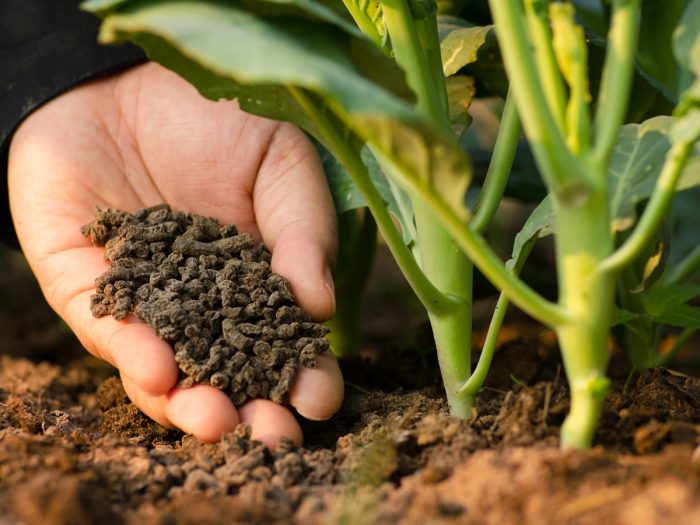
Organic fertilizers are derived from animal matter, animal excreta, human excreta, and vegetable matter. Photo Credit: Shutterstock
On-Farm Production
The majority of organic fertilizers can be prepared locally or on the farm itself. Hence, the cost of these fertilizers is much lower than the cost of chemical fertilizers.
Low Capital Investment
In addition to the on-farm production possibilities of organic fertilizers, organic fertilizers help in maintaining the soil structure and increasing its nutrient-holding capacity. Therefore, a farmer who has practiced organic farming for many years will require far less fertilizer, because his soil is already rich in essential nutrients.
Fertile Soil
Organic fertilizers ensure that the farms remain fertile for hundreds of years. Land located at the site of ancient civilizations, such as India and China, are still fertile, even though agriculture has been practiced there for thousands of years. Fertility is maintained because organic fertilizers were always used in the past. However, with the increased use of chemical fertilizers today, the land is rapidly becoming infertile, forcing many farmers to further increase their use of chemical fertilizers or even leave the farming industry entirely.
Safe Environment
Organic fertilizers are easily bio-degradable and do not cause environmental pollution. On the other hand, chemical fertilizers contaminate both the land and water, which is a major cause of diseases for human beings and is the force behind the extinction of a number of plants, animal, and insect species.
Employment
We all know that chemical fertilizers are made in large plants that are automated and have an annual capacity of millions of tons. Organic fertilizers, on the other hand, are prepared locally and on a much smaller scale. As a result, the production of organic fertilizers leads to employment, especially in rural areas where employment opportunities can sometimes be bleak.
Why do You Need Fertilizers?
Why do you need fertilizers for gardening or farming? Do plants not grow in the wild without any fertilizers? The answer to this question lies in the fact that you only want specific species of plants to grow on a farm or a garden.
Soil, on farms as well as the wild, has nutrients in it. However, the proportion of minerals is different in different places. Within a field, the nutrient content is similarly not uniform. In the wild, plants that are most suitable to the soil and other conditions grow and you don’t have any control over their growth. However, since you want to grow only your favored variety of plants in your garden or farm, you need to add nutrients according to the needs of that variety and availability in your soil.
Moreover, in a partially covered piece of land, such as a farm, the soil nutrients are taken up by the plants but are not replenished when the plants or their leaves die, because you remove them as food, herbs, etc. Hence you require fertilizers to enrich the nutrient-deficient soil and create artificial conditions for higher productivity of the plants.
What are these nutrients required by plants? The most commonly required plant nutrients are nitrogen (N), phosphorus (P) and potassium (K). Almost all fertilizers are categorized according to their Nitrogen-Phosphorus-Potassium or N-P-K value. Nitrogen is required for the growth of vegetative parts such as the stems and the leaves, while your plants will have healthy roots if they get a sufficient amount of phosphorus. Phosphorus is also required for good flowers and fruits. Potassium makes the plant healthy by facilitating the circulation of nutrients within the plant. [1] [2] [3]
In addition to N-P-K, plants also require other nutrients, such as calcium and magnesium. Since these are required in small quantities, you need not to add them separately unless in exceptional cases, if your soil is totally devoid of these minerals or the crop you wish to grow requires them in large quantities.
How to Use Fertilizers?
Farmers have the conception that adding large quantities of fertilizers in their farms will only be beneficial to their plants. However, according to The Royal Horticultural Society, since fertilizers are substances that are rich in nutrients, they are meant to be added in small quantities. The society suggests the following points for fertilizer application: [4]
Soil Analysis: A thorough analysis of the soil should be conducted before planting the crops. You should first find out the existing nutrient content of your soil, find out the nutrient requirement of the plants you want to grow, and add fertilizers based on the nutrient deficiency between the two. A typical soil analysis test will determine the soil texture, organic matter content, and pH. It will also give you the content of different minerals such as phosphorus, magnesium, and potassium. Some soil test labs also determine the micro-organic activity in your soil.
Time of Application: The time when you apply the fertilizers is also crucial. In cold climates, fertilizers should not be applied during winter and autumn, as they will favor young growth during the winter. Since the weather is harsh during this time, the plants won’t be able to survive for long. Therefore, fertilizers should only be applied during the spring. In fact, the time for adding the fertilizers and preparation of the crop should be quite close.
The quantity of Fertilizers: Society suggests that if a farmer is in doubt about the quantity of fertilizer to be added, he should add less fertilizer to be on the safe side.
Organic Fertilizers: It is also suggested that farmers prefer organic fertilizers to chemical fertilizers.
Global awareness for the hazards of long-term chemical fertilizer use is growing. Because of this, more and more farmers all over the world are shifting to organic fertilizers. The agricultural market has also recognized this trend and has recently employed a full-blown campaign to promote organic and natural fertilizers. Among the benefits of using organic fertilizers are non-toxic food, lower cost, better soil fertility, and of course, a safer environment.
What is Compost?
One of the best features of organic gardening is the ability to locally produce the fertilizers, pesticides, and other organic ingredients. And the easiest among them is compost. You can prepare compost almost anywhere, even in your kitchen garden!
Agricultural scientists all over the world agree that compost is an excellent source of organic matter for garden plants. Compost provides air, water, organic matter, and microorganisms to your plants, thus enhancing their growth. It also maintains a healthy atmosphere for the soil and hence keeps insects, plant diseases, and weeds away.
What are the Benefits of Compost?
So what is so special about compost? Why not use organic matter directly? The biggest advantage of using compost is that the organic matter in compost is partially decayed, so its volume is much lower. Furthermore, the microorganism activity has started in the compost already, so the concentration of these microorganisms is very high. This makes the compost a concentrated and easy to absorb the source of organic matter for the growing plants.
Where can you buy compost? You can purchase compost from the market, as well as online stores. Compost for Sale is a directory of some companies that sell compost in the UK, US, and India. [5]
You can also prepare compost in your own garden. Composting on a small scale can be done through the following three techniques:
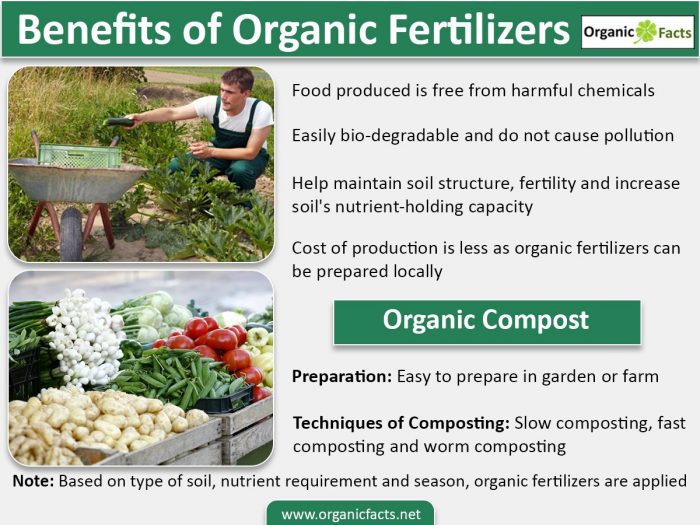
Organic fertilizers are biodegradable and environment friendly. Photo Credit: Shutterstock
Fast Composting: Fast composting is a composting technique used by many biodynamic farmers. A pit of 1m height, 1m width, and 1m length is prepared. The length of the pit can be increased according to the space available in your garden and your compost requirement. The pit is filled in with a thin layer of leaves, manure, and straws. Water is added after adding each layer. You can also add some soil between these layers. The pile should be turned regularly to keep it aerated. Compost will be ready within six to eight weeks.
Slow Composting: Slow composting, as the name suggests, is a very slow process and it takes a number of months for compost formation through this method. Organic matter that is rich in carbon (brown organic matter such as sawdust) is the main ingredient. Fill half of the composting pit with carbon-rich organic matter, and every day, add kitchen waste or vegetable peelings to this mixture. You can also add soil along with the kitchen waste occasionally. The pit’s contents will gradually decompose and you can start harvesting the compost from the bottom of the pit.
Worm Composting: Worm composting, also known as vermiculture, can be carried out in a bin or in a trench. Fill the bin or trench with soil and organic matter (kitchen waste or vegetable peelings). Then, release red worms into the bin. Ensure that the bin is always moist, but don’t add too much water. Adding water in large quantities will fill the pores built by the worms with water and disturb their colony. You can also make a hole in the bin for purging out any excess water. Some researchers also suggest using earthworms instead of red worms, since earthworms are more effective in converting organic matter into manure. The compost will be ready in a few weeks. While harvesting the compost, take care that you don’t hurt the worms.
Quality of Organic Fertilizers
When you prepare compost or organic fertilizers, you can add a variety of organic matter to make the compost. The quality or nutrient value of the compost depends on what organic matter you add to it. Also, if you are purchasing organic fertilizers, you should try to know the nutrient content of the organic fertilizers before purchasing them. Just like chemical fertilizers, organic fertilizers also have an N-P-K (nitrogen potassium and phosphorus) value.
The NPK value for organic fertilizers depends on the organic matter used for preparing them. Organic matter such as dried blood and fish meal are rich in nitrogen. Fish meal is also rich in phosphorus. Kelp, on the other hand, is rich in potassium. The ability of different types of organic matter to release nutrients is also not the same. Therefore, the availability of nutrients is also an important criterion when selecting the type of organic fertilizer.
The Cornell Cooperative Extension and The Utah State University Extension have provided the nutrient value of different organic matter in their guides Fertilizing Garden Soils and Selecting and Using Organic Fertilizers, respectively. Some of these values are tabulated below: [6] [7] [8]
| Organic Matter | % Nitrogen | % Phosphorus | % Potassium | Availability of Nutrients |
| Alfa Alfa Hay | 2-3 | 0.5-1 | 1-2 | Medium |
| Bone Meal | 1 | 11 | 0 | Slow |
| Cottonseed Meal | 6 | 3 | 1 | Slow |
| Compost | 1.5 | 0.5 | 1 | Slow |
| Dried Blood | 12 | 1.5 | 0.5 | Rapid |
| Feather Meal | 12 | 0 | 0 | Medium |
| Fish Meal | 10 | 4 | 0 | Slow |
| Grass Clippings | 1-2 | 0-0.5 | 1-2 | Medium |
| Horn Meal | 12-14 | 1.5-2 | 0 | Medium |
| Kelp | 1 | 0.5 | 9 | Rapid |
| Leaves | 1 | 0-0.5 | 0-0.5 | Slow |
| Legumes | 2-4 | 0-0.5 | 2-3 | Medium |
| Cow Manure | 0.25 | 0.15 | 0.25 | Medium |
| Horse Manure | 0.3 | 0.15 | 0.5 | Medium |
| Sheep Manure | 0.6 | 0.33 | 0.75 | Medium |
| Swine Manure | 0.3 | 0.3 | 0.3 | Medium |
| Pine Needles Manure | 0.5 | 0 | 1 | Slow |
| Poultry Manure | 2 | 2 | 1 | Rapid |
| Saw Dust Manure | 0-1 | 0-0.5 | 0-1 | Slow |
| Sewage Manure | 2-6 | 1-4 | 0-1 | Moderate |
| Seaweed Manure | 1 | 2 | 5 | Rapid |
| Straw Manure | 0-0.5 | 0-0.5 | 1 | Slow |
| Wood Ashes | 0 | 1-2 | 3-7 | Rapid |