Bookmark and Share RSS
Difference Between Organic and Natural Food
User Rating: / 41
PoorBest 
Organic Food Basics

“What is the difference between organic and natural food?”. Many people think that there is no difference between the two and both mean the same. But this is not true. If you compare organic and natural from their definitions, the difference will be clear.

Organic food refers to food items that are produced, manufactured and handled using organic means defined by certifying bodies such as the United States Department of Agriculture (USDA) under its Organic Food Products Act. Natural food, on the other hand, generally refers to food items that are not altered chemically or synthesized in any form. These are derived from plants and animals. Thus a natural food item is not necessarily organic and vice versa.

ApplesBut the important question is - "Why do some people prefer organic food and some people prefer natural food?" This is because some people have the belief that synthesizing a food item results in loss of its nutrients and properties. Hence they demand natural foods. Organic food fans, on the other hand, want their food to be free of chemical fertilizers, pesticides and preservatives.

Apparently, the demand for organic food is more than natural food because organic food seals are granted and monitored by the government. An act similar to the Organic Food Products Act is necessary for the natural food products as well.

Given below is the difference between natural and organic food on different parameters:

Parameter Organic Food Natural Food
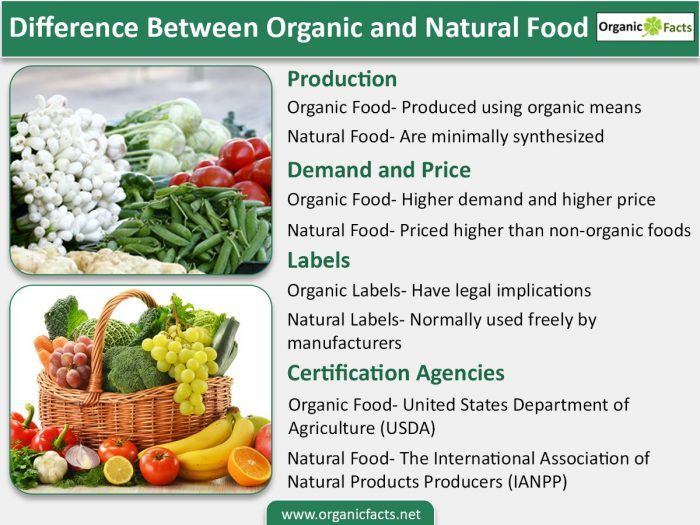
Definition Organic food refers to items that are produced using organic means. Natural food items are minimally synthesized.
Standards Stringent standards for organic food production, handling and processing exist throughout the world. Stringent standards do not exist for natural food products in many parts of the world.
Certification Bodies Many countries have certification bodies, the most prominent being the United States Department of Agriculture (USDA). The International Association of Natural Products Producers (IANPP) is trying to get the definitions for natural food into place. It should be noted that it is not a certification body.
Labels Organic labels have legal implication. A manufacturer should follow the specified rules and regulations before using the organic label. Natural labels are normally used freely by manufacturers due to lack of adequate guidelines.
Demand Demand for organic food is more than the demand for natural food. The demand for natural food is also increasing; however, not as much as organic food.
Health Benefits There is no evidence to prove that organic food is healthier than non organic food. People prefer organic food because they feel it is safer than conventional food as chemicals are not used in its production. However, recent research on the health benefits of organic milk has boosted the spirits of organic food lovers. People prefer natural food because they believe excessive processing of food items disturbs their health benefits.
Price Organic food is priced more than non organic food. Natural food is also priced more than non organic food
Shelf life Shelf life of organic food is more than that of natural food. You can store it for a longer duration. Since it is minimally processed in many food items, which have high water content, the shelf life is low.
Availability Organic food is being sold in almost every super market. There are special stores selling organic food and one can purchase organic food online as well. Natural food is available at many stores that sell organic food. There are some special stores that sell natural food. Further, many stores selling health food items also sell natural food products.


The photos on this page is credited to vnysia


Bookmark and Share RSS
Discussion Board
Add New RSS
Ask a question or share your views
barbara  - very helpful thanks alot 2010-02-21 22:35:32
this article was very helpful i really needed a article for my science project and this is just what i was looking for thanks you realy should write more and in my opinion organic foods taste better and are heathier than chemically grown foods
barbara  - very helpful thanks alot 2010-02-21 22:33:49
this article was very helpful i really needed a article for my science project and this is just what i was looking for thanks you realy should write more and in my opinion organic foods taste better and are heathier than chemically grown foods
barbara 2010-02-21 22:31:11
this article was very helpful i really needed a article for my science project and this is just what i was looking for thanks you realy should write more and in my opinion organic foods taste better and are heathier than chemically grown foods
Alisa  - Can you wright more?Please? 2010-02-14 20:03:34
I was very interested in your article. Will you please write more?
Kierney  - correction. 2010-02-08 02:58:31
studies show that organic foods are healthier than non organic food because that have 63% more calcium, 73% more iron, 125% more potassium, 60%more zinc, and 29% less mercury.
Rich  - Where is the data on this? 2010-02-08 08:19:28
A report from July 2009 out of London states there is know significant difference in nutritional vlue of any of the items you mention to warrent any benefit of Organic food over conventional food. Show facts to be believed. There are no facts to that end by the way.
Rich  - http://www.guardian.co.uk/environment/2009/jul/29/ 2010-02-22 06:56:13
My info is from a study I found in the Guardian. I also have a degree in biology and I am very aware of environments and how there really are no closed environments for growing food in an affordable way. I think alos that food labeling is farce in many countries so buyer beware.
Sheida Ayana  - Whole foods 2010-02-01 21:07:51
As long as it's good && safe for me to eat, ii could care less whether it's organic or natural. Eitha way, I'm gonna eat it. lol
Kristen  - feed 2010-01-31 19:25:20
It's not "natural" for a cow to eat corn or corn products. It gives them infections because their bodies were not designed to digest anything but grass; E.Coli then becomes a problem.
Wade  - false biased claims 2010-02-01 20:05:24
scientifically that is B.S., cattle are ruminants that use microbial fermentation to digest food. Science has proven they adjust propionate, acetate, and butyrate levels in the rumen for many types of food intake.
Mitxie  - Whole Foods vs Henrys/Trader Joes 2009-10-27 12:49:19
I love Whole Foods, I mean its a food lovers delight - but the prices are crazy...Henrys and Trader Joes are good prices but are they ok for buying meat? Cant a guy eat healthy without paying an arm and a leg!
Smoke Weed Eat Quinoa  - list 2009-09-15 13:52:12
I think as far as the "list of organic foods" goes. Good luck. More importantly look for a list of lets say..."The ten most chemically driven fruits/vegetables"
Smoke Weed Eat Quinoa  - Organic 2009-09-15 13:47:45
For all you students...
Do note that eating organic natural foods and living an organic natural lifestyle goes much beyond the basic idea that eating organic natural is the healthiest choice. Due to the fact that the soil lacks pesticides your doing better for the earth itself as well as what ever's growing from it. I think it's safe to say most org/nat food buyers are also more eco-friendly as well; when shopping at a coop you have recycled toiletry options etc. in which are becoming more and more available at most chain grocers. Also note that natural at a cooperative is going to mean something totally different than natural at a chain grocer, so different and mixed up that you mind as well ignore the word. No source sorry.
Sue Gratter  - Organic v. Natural 2009-07-10 14:30:54
The most important fact to remember is that there is no certification for Natural. So-called Natural Beef could have been fed a very unnatural, feedlot diet, shot-up with growth hormones and antibiotics, on a factory farm (read confined, not grazed in a pasture) but after slaughter, had nothing added to it. Then they call it natural. Really, it is full of pesticides, hormones, etc. They are only calling the "end product" natural. It's just a way to get around the organic specifications and FOOL THE PUBLIC!
Lael Schoessler 2009-11-23 07:55:13
what exactly is "unnatual" about a feedlot diet? they primarily eat hay and various corn products. hay grows the same way as the pasture does its just cut and stacked. people dont know anything. all they see is the animal rights side and dont really know what goes on. get your shit straight.
shamila  - organic food 2009-05-07 07:49:08
i agree
Charlotte Richard  - Ms. 2009-04-25 14:44:33
I have a dip with Jalapeno,Cilantro and Hummus in it from Whole Foods Market and boy is it goooood. I just wanted to know what hummus was. I'm not sure if I remember correctly. Does any one know?
claireallison  - HUMMUS 2009-05-04 20:02:02
Hummus is a blend of chickpeas (usually) mixed with oil and lemon juice -also seasonings and vegetables (in your case jalapeno,) with cilantro. So yummy I agree!
kid man  - kool 2009-05-11 08:16:28
that sounds kind of good hahaha lmao lol
bikash  - Hummus ..i think it is spelt "Humus" 2009-06-02 17:00:35
hummus is the name for the top soil ( brownish black in colour) which is composed of all the biomass including decomposed leaves, excreta..etc and is supposed to be congenial for plant growth coz of the presence of organic matter.
dhamotharan  - pepper quality 2009-04-12 00:49:32
Hi,

Can you pls let me know how do i find the definition of MG1 and other quality peppers..

Thanks & Regards
Dhamotharan
Naaj  - organic v/s conventional 2009-03-07 11:56:08
Hi all im making project on organic foods.......if anyone of you wanna know much abt organic food u can mail me.......my id is..... nehaaggarwal50@yahoo.com
sanjay  - actual difference of organic and natural food ? 2009-02-09 04:57:48
i cant understand what is diff. of organic and natural food?how can understand non certified food is natural or organic ?
pt  - Cost 2009-02-04 06:04:33
Organic foods are more expensive, that's the most consistent difference. There are many non-organic foods that are good for you. Don't be swept away by marketing hype. At the same time, there are many non-organic foods you should never eat. Be smart. Don't just be a follower.
Lakotah  - I was wondering... 2009-02-02 17:17:34
hello, I'm doing a science project on Organic V.S Non-Organic. And it says organic food isn't actually heathier for you except for organic milk, and organic tomatoes. I was wondering... is that true. Anways THANKS!
Courtney Bertrand  - Food Studies 2009-01-20 14:47:43
I, recently went back to school without the help of books. My question for you is, What is the different between organic foods and other types. Thanks if you can help. Its not only for my studies it would better my families eating habits. Thanks Courtney
jonnie-rose  - diif 2009-01-09 06:23:48
i need to no every thig about organic
jonnie-rose  - diff 2009-01-09 06:22:12
cool i love this website
geena  - foods 2008-10-19 14:06:08
whats the difference between organic and non-organic and natural foods??
Dave 2008-10-15 17:01:16
Are these sources credible? All of the published journal articles I've read say that there are no proven benefits of organic food. It would be much appreciated if you could supply any information needed to prove that these are credible sources.
michaela 2008-10-14 10:32:20
im also doing a report and i need the author's name.
kizzy  - list of organic food 2008-08-27 08:17:46
hi my name is kizzy and i would like to know if you can send me a list of organic foods.thank you in advance.TH
Rich 2008-08-30 13:32:38
I don't think such a list exists. There are organic versions of many many food items in your grocery store. You might start by looking for organic alternatives to things you already like to purchase at the. Just look for the word "organic" on the package. There is probably an organic version for (almost) all fruit and vegetables. Meat, too. Ask at the store. You'll also find organic versions of some "processed" foods (bread, peanut butter, frozen meals), but you may have trouble finding organic cookies and crackers. Also, upscale stores will have more organic items: Whole Foods probably has more than Walmart.
f
Write comment
Name:
Email:
 
Title:
 
Please input the anti-spam code that you can read in the image.