The standards for organic honey production are much different than those for producing other organic livestock products. Managing honey bees is very difficult, so the general rules applicable for other livestock cannot be implemented in the case of organic honey production.
The National Standard of Canada, instituted by the Government of Canada, has provided standards for organic honey production in their document the “Organic Production Systems General Principles and Management Standards”. The North London Beekeeping Association has also summarized the organic honey standards widely used in the UK in one of its information sheets.
Organic Honey Standards
The commonly used production guidelines have been given below (please note that the guidelines and the numbers given below are indicative):
Location of Organic Apiary
An organic apiary should be placed on a piece of land that is maintained organically. The nectar, honeydew, or pollen used by the honey bees should come from organic sources. Normally, a honey bee can travel up to 3 km for gathering honey. Hence, any chemical farms in the vicinity should be located outside a distance of about 3 km.
Organic Bee Hives
The beehives used for organic apiculture should be made of natural timber or metal. Treated timber cannot be used for making the hives. Furthermore, lead-based paints should not be used and if plastics are used, then they should be covered with bee wax.
Transition Period
Like organic milk production, there is a transition period involved when a farmer shifts from conventional honey production to organic production. This transition period is about 12 months. Non-organic wax should be replaced with organic wax during this transition period.
Origin of Honey Bees
The replaced or introduced honey bees can come from organic as well as non-organic apiaries. The apiary where new honey bees have been introduced can be included in organic honey production only after a period of about 60 days, after ensuring the replacement of bees and the management of the apiary has been carried out through organic means.
Feed for Organic Honey Bees
In the organic apiculture, the honey bee hives should not be placed in or near farms where chemical farming is being practiced. Also, artificial feeding can be carried out; however, this should only be done when it is difficult to provide access to organic foraging to the bees. When non-organic feed is used, the apiary should be removed from organic honey production, depending on the duration of artificial feeding.
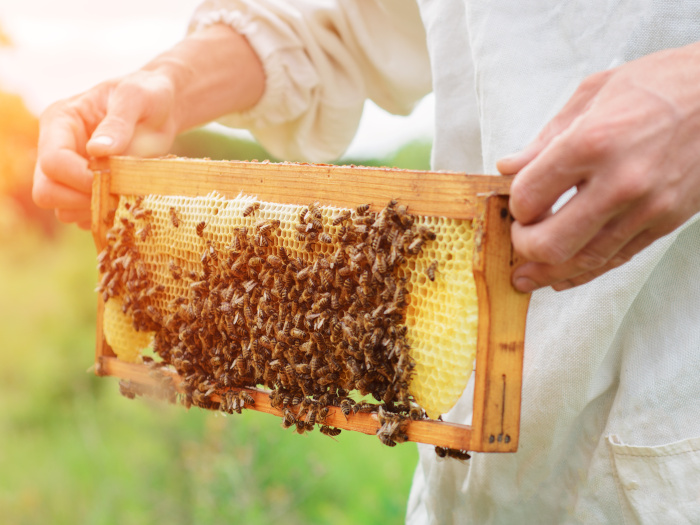
An organic apiary has to follow strict quality standards. Photo Credit: Shutterstock
Queen Honey Bees
The queen honey bees can be replaced whenever required. A healthy queen should be selected for a replacement to ensure preventative disease management. Sometimes, artificial insemination is also permitted. Cutting of the wings of the queen honey bee is not permitted.
Disease Control
Stress should be put on using preventative methods of disease control, such as selecting healthy queen honey bees and replacement bees. Furthermore, antibiotics cannot be used for treating diseases. Whenever antibiotics are used, the apiary should be isolated and kept out of organic honey production for at least a year.
Extraction
A live brood cannot be used for extracting honey from a brood comb. The surfaces that come in contact with the honey should be made of a food-grade material or should be coated with beeswax.
Processing
It should not be heated above 35 degrees Celsius. Gravitational settling and filtration should be used for removing extraneous solids.
Labeling
Every apiary should be properly managed and records of the apiary should be maintained. One should be able to trace the honey stored in an organic honey jar to the apiary it has been obtained from.
Benefits of Organic Honey Certification
An increasing number of farmers all over the world are shifting to organic farming since it provides numerous benefits over conventional farming. Honeybee keepers are also favoring organic honey production, as it is considered to have numerous benefits over conventional honey.
The NSW Department of Primary Industries, Australia provides the pros and cons of becoming a certified organic honeybee keeper in the document ‘Organic Certified Production with Bees’. [1]
Positives of Organic Honey Production
Some of the advantages of organic honey production to manufacturers are given below:
- Increased Price of Honey: Organic honey and organic raw honey both fetch a higher price in the market as compared to conventional honey.
- Increased Marketability: It is easier to sell organic honey and raw organic honey, as they are considered to have greater health benefits over non-organic honey. Reports of increased usage of antibiotics in Chinese honey have increased awareness about the potential ill effects of non-organic honey among health-conscious consumers.
- Quality Honey Assurance for Buyers: Customers are assured of a quality product as the production and handling standards for organic honey are clearly defined by the certifying body. If the honey is not manufactured according to the set guidelines, then the organic label is not granted.
- The satisfaction of Producing a Clean Product: Many farmers shift to organic farming due to its benefits to the environment. The same is the case with organic apiculture. Organic honeybee keepers feel content at the end of the day when they do not use chemical pesticides and antibiotics.
- Every Organic Honey Jar Can be Traced: Certified organic honey involves proper labeling of the product. Every organic honey jar can be traced to the honey bee hive from which the honey in it is obtained.
- Increased Management Awareness of the Enterprise: Many conventional honeybee keepers are not aware of effective techniques to manage their apiaries. Since certified organic honey production involves following stringent guidelines, manufacturers are also educated about the efficient management of their enterprise.
Negatives of Organic Honey Production
Despite the many benefits of organic honey, there are some disadvantages of organic honey production. Some of these disadvantages include the following:
- Availability of Suitable Apiary Sites: It is difficult to get suitable apiary sites that favor the organic honey standards in all seasons.
- Limitation on Disease Management Practices: Organic honey does not involve the wide usage of antibiotics. Therefore, disease management is restricted.
- Limitation on Feeding Management Practices: An organic honeybee keeper has to ensure that there are no non-organic farms in the vicinity of his honey bee hives. Furthermore, there are other restrictions on feeding practices.
- Transition Cost and Time: A conventional honeybee keeper cannot shift to organic honey production all of a sudden. As in the case of organic milk production, there is a transition time and cost involved in shifting to this type of production as well. There is also a one-year probationary period in some countries, such as Australia, before becoming a certified organic honey manufacturer.
- Other Costs: The production also involves other costs such as the cost of joining the certifying body, the cost of certification, auditing cost, sampling cost, etc.
- Increased Record-Keeping: Organic honey involves keeping detailed records throughout the manufacturing, processing, and retailing processes.