Refined coconut oil is the most widely used form of coconut oil worldwide, if not the purest or the best. It is also known by the name of RBD coconut oil, which stands for refined, bleached, and deodorized coconut oil.
Copra is the dried kernel from which the oil is extracted. The oil that is expelled directly from copra is not fit for consumption, since it may contain dust particles, insect remains, spawns, microbes, fungal spores and many substances that may be harmful to health. You may wonder how these foreign substances get into coconut oil. If you have ever seen how coconut kernels are dried into copra, you would understand. [1]
In almost every case, the kernels are cut open and spread open in the strong sun to dry, with their flesh facing the sun. They are kept like that for days, weeks, or even months until they dry up as desired. They are not even covered with nets. Perhaps now you can imagine what happens in that time. Dust and every other possible inedible substance could fall into them at any time.
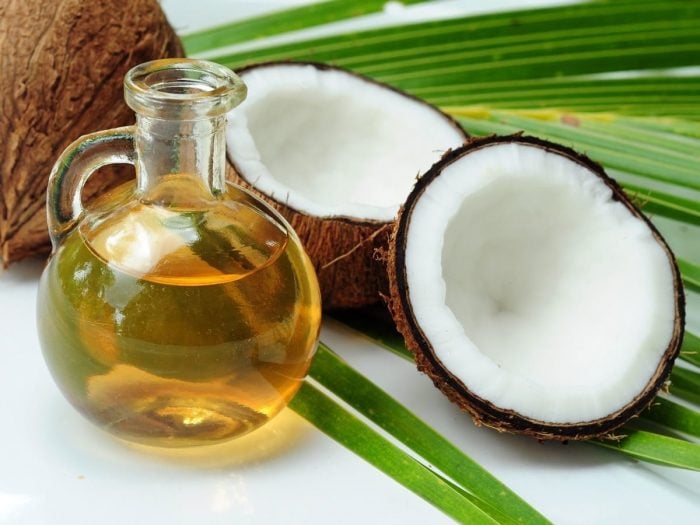
The most-loved coconut oil Photo Credit: Shutterstock
Furthermore, all those curious insects, birds, rodents, and other animals pay regular visits to see or rather taste, what’s happening. Again, in the absence of sufficiently strong sunshine or in cloudy weather, there are plenty of chances for fungal growth in the kernels, which are neither thrown away nor cleaned before the oil is extracted. Basically, for our own safety, we are left with no choice but to clean the oil instead. To understand that extraction and cleaning process a bit more clearly, we have delved into it a bit deeper in the following sections.
Extraction of Refined Coconut Oil
There is no special technique involved in the extraction of refined coconut oil. In fact, no coconut oil is refined when it is expelled. It is expelled from copra using a bullock or machine-driven expeller, just like any other oil. [2]
Refining, Bleaching, and Deodorizing
Both refined and unrefined coconut oils have the same nutritional benefits. Photo Credit: Shutterstock
The crude oil is first repeatedly filtered to obtain a clean filtrate. The oil is also bleached in the process, as this filtration is done using calcareous clays. Then, it is heated to a very high temperature, which serves a dual purpose. It deodorizes the oil, while also killing the germs or fungal spores within it. Afterward, sodium hydroxide (Na (OH) 2) is added to it and it is further filtered to remove the mono-fats or free fats. Finally, in some cases, it is hydrogenated to ensure that no unsaturated fatty acids are left in the oil, which elongates the shelf life considerably.
Difference from Pure Coconut Oil
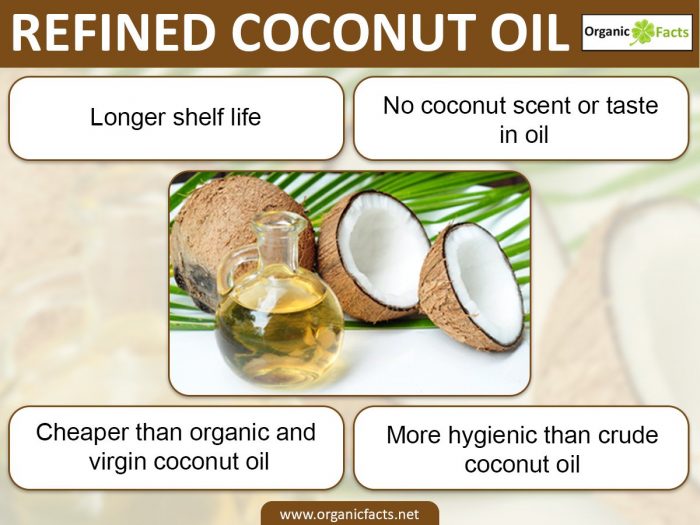
Refined coconut oil differs from pure coconut oil in many respects. First, you won’t find the typical coconut scent or taste of coconut in the oil, unlike in pure coconut oil. This deodorization is deliberate because, despite some people’s preference for the scent of coconut in their cooking oil, there are just as many who don’t. [3]
Being refined, it is certainly more hygienic than the crude coconut oil, but not that beneficial from the point of view of health. It is left with almost no proteins or minerals due to this processing. However, its shelf life is longer than that of crude or pure coconut oil.
Prices
It is certainly a bit more expensive than the crude coconut oil (the refining, bleaching and other processing charges add to the base cost). However, it is cheaper than the same crude oil when it comes with a pure coconut oil tag. Again, it is far cheaper than organic coconut oil, virgin coconut oil, and organic virgin coconut oil.
Availability
Refined coconut oil is the most easily available, most sold, and most consumed form of coconut oil. In fact, nearly all the coconut oil that comes packed in bottles, sachets and bigger packs in the market is refined coconut oil.
For a regular person like me, who is an occasional user of coconut oil and not one who is going to write a thesis on refined coconut oil, this is all you need to know regarding refined coconut oil. Be safe, and enjoy!