The health benefits of plums may include relief from indigestion, influenza infections, weight loss, and anxiety-related problems. Plums’ potential antioxidant power can help to prevent and manage osteoporosis, macular degeneration, diabetes, and obesity. Additionally, plums may also improve cognition, boost immunity, keep the nervous system healthy, and aid in skin care. [1]
What are Plums?
Plums or Prunus domestica are round-sized fruits that belong to the Rosaceae family, including peaches, apricots, and nectarines. They exist in diverse colors and shapes with over 2000 different varieties. Plums belong to three groups: European-Asian (Prunus domestica), Japanese (Prunus salicina), and Damson (Prunus insititia). China is the leading harvester of plums, followed by the United States, Serbia, and Romania. Within the US, the primary production of plums happens in California. [2]
They are small deciduous trees that grow to a height of about 10-15 meters and bear fruits with different characteristics based on the country of origin. They are drupes or stone fruits with a smooth pit and a crease running down on one side. They contain juicy pulp varying from creamy yellow to crimson red. The color of the outer skin may vary considerably from yellow or dark red to purple or black.
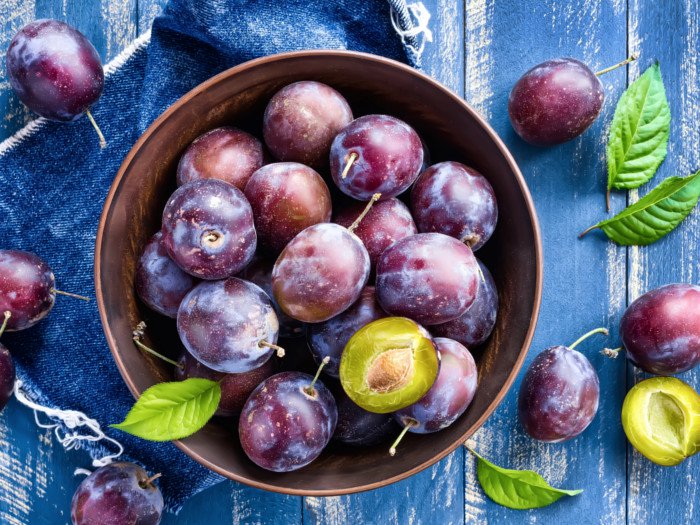
Plums are loaded with an assortment of healthy compounds, vitamins, and minerals. Photo Credit: Shutterstock
| Serving Size : | |
|---|---|
| Nutrient | Value |
| Water [g] | 87.23 |
| Energy | 46 |
| Energy [kJ] | 192 |
| Protein [g] | 0.7 |
| Total lipid (fat) [g] | 0.28 |
| Ash [g] | 0.37 |
| Carbohydrate, by difference [g] | 11.42 |
| Fiber, total dietary [g] | 1.4 |
| Sugars, total including NLEA [g] | 9.92 |
| Sucrose [g] | 1.57 |
| Glucose (dextrose) [g] | 5.07 |
| Fructose [g] | 3.07 |
| Maltose [g] | 0.08 |
| Galactose [g] | 0.14 |
| Calcium, Ca [mg] | 6 |
| Iron, Fe [mg] | 0.17 |
| Magnesium, Mg [mg] | 7 |
| Phosphorus, P [mg] | 16 |
| Potassium, K [mg] | 157 |
| Zinc, Zn [mg] | 0.1 |
| Copper, Cu [mg] | 0.06 |
| Manganese, Mn [mg] | 0.05 |
| Fluoride, F [µg] | 2 |
| Vitamin C, total ascorbic acid [mg] | 9.5 |
| Thiamin [mg] | 0.03 |
| Riboflavin [mg] | 0.03 |
| Niacin [mg] | 0.42 |
| Pantothenic acid [mg] | 0.14 |
| Vitamin B-6 [mg] | 0.03 |
| Folate, total [µg] | 5 |
| Folate, food [µg] | 5 |
| Folate, DFE [µg] | 5 |
| Choline, total [mg] | 1.9 |
| Vitamin A, RAE [µg] | 17 |
| Carotene, beta [µg] | 190 |
| Cryptoxanthin, beta [µg] | 35 |
| Vitamin A, IU [IU] | 345 |
| Lutein + zeaxanthin [µg] | 73 |
| Vitamin E (alpha-tocopherol) [mg] | 0.26 |
| Tocopherol, gamma [mg] | 0.08 |
| Tocotrienol, alpha [mg] | 0.04 |
| Tocotrienol, gamma [mg] | 0.01 |
| Vitamin K (phylloquinone) [µg] | 6.4 |
| Fatty acids, total saturated [g] | 0.02 |
| 16:0 [g] | 0.01 |
| 18:0 [g] | 0 |
| Fatty acids, total monounsaturated [g] | 0.13 |
| 16:1 [g] | 0 |
| 18:1 [g] | 0.13 |
| Fatty acids, total polyunsaturated [g] | 0.04 |
| 18:2 [g] | 0.04 |
| Phytosterols [mg] | 7 |
| Tryptophan [g] | 0.01 |
| Threonine [g] | 0.01 |
| Isoleucine [g] | 0.01 |
| Leucine [g] | 0.02 |
| Lysine [g] | 0.02 |
| Methionine [g] | 0.01 |
| Cystine [g] | 0 |
| Phenylalanine [g] | 0.01 |
| Tyrosine [g] | 0.01 |
| Valine [g] | 0.02 |
| Arginine [g] | 0.01 |
| Histidine [g] | 0.01 |
| Alanine [g] | 0.03 |
| Aspartic acid [g] | 0.35 |
| Glutamic acid [g] | 0.04 |
| Glycine [g] | 0.01 |
| Proline [g] | 0.03 |
| Serine [g] | 0.02 |
| Sources include : USDA [3] | |
Nutritional Value of Plums
According to the USDA FoodData Central, they can be an excellent source of vitamins such as vitamin A, vitamin C, folate, and vitamin K. They are also a possibly good source of vitamin B1 (thiamine), B2 (riboflavin), B3 (niacin), B-6, and vitamin E (alpha-tocopherol). The minerals present in them include potassium, fluoride, phosphorus, magnesium, iron, calcium, and zinc. Moreover, they may supply dietary fiber and offer low calories without any harmful fats. [4]
Health Benefits of Plums
Plums contain an immense range of phenols and flavonoids, which offer an impressive health benefits array. Let us know more in detail. [5]
Potential Antioxidant Properties
These fruits contain vitamin C and potentially vital phytonutrients that possess antioxidant properties. These properties can help in preventing the damage caused by oxygen radicals and possibly shield the body against fatal diseases. A study published in the Journal of Medicinal Food concluded that the phenols present in plums may also extend their protective effect on the essential fats in the neurons and cell membranes against any injuries caused by oxidative stress. [6]
May Manage Diabetes
Plums can exert potentially anti-hyperglycemic effects and can help in combating diabetes. A study published in Biomedical Research journal has shown that plum extracts can aid in reducing blood sugar and triglyceride levels in the body. Another study published in The British Medical Journal states that the flavonoids present in plums may exert protective effects against insulin resistance and can help lower the risk of type-2 diabetes. [7] [8]
May Prevent Osteoporosis
Consumption of dried plums exerts anabolic and anti-resorptive actions, which may aid in maintaining healthy bones. Polyphenols, along with the potassium content present in dried plums, can encourage the bones’ formation, may improve bone density, and can also prevent bone loss. A research study published in the Journal of Nutrition demonstrated that regular consumption of dried plums might help restore bone density that is lost due to aging. [9] [10]
May Aid in Digestion
They can be a good source of dietary fibers that can help in regulating the digestive system. According to a research study published in the Alimentary Pharmacology and Therapeutics Journal, dried plums or prunes can be more effective in treating gastrointestinal disorders such as constipation compared to other remedies such as psyllium husk. [11]
May Help in Nervous System’s Smooth Functioning
Plums may contain possibly high amounts of vitamin B6, which may help in the transmission of nerve signals and can aid in the nervous system’s smooth functioning. Tryptophan, an amino acid present in plums, can help produce neurotransmitter serotonin improving sleep, appetite, and concentration. They might help in the brain’s healthy growth and can also assist in the formation of mood-influencing hormones. [12]
May Protect Heart Health
Researchers from The British Journal of Nutrition provided supporting evidence stating that the regular intake of dried plums can help promote fluidity of blood in the arteries. This protective effect may aid in the prevention of various cardiac disorders, including atherosclerosis. [13]
May Boost Immunity
Plums can be beneficial in strengthening the body’s immune defense due to the presence of high vitamin C content. This vitamin can promote the body’s resistance to infections and inflammations. Research has shown that oriental plums have immunostimulatory constituents that can encourage nitric oxide production in the body, and can also be valuable in preventing various diseases. [14]
May Regulate Cholesterol Levels
Dried plums or prunes can help in preventing hypercholesterolemia and hyperlipidemia. A comparative study in the American Journal of Clinical Nutrition has proven the efficacy of prunes over grape-juice in maintaining normal plasma and liver cholesterol levels. The possibly high fiber content present in them can give a protective effect on the heart by reducing LDL or bad cholesterol and elevating HDL levels or good cholesterol. [15] [16]
May Aid in Skincare
They are rich in vitamin C, and other antioxidants, which can help maintain healthy, radiant, and youthful skin. It can also help in reducing dark spots and wrinkles due to the presence of anti-aging nutrients. Plum extracts come to use in various skin care products which may include face wash and face packs. [17]
Culinary Use
People use plums in food items due to their sweet and tart flavor, as well as their pleasant aroma. They can be enjoyed fresh and are an excellent addition to puddings, jams, and jellies. Alternatively, plum juice is useful in the preparation of alcoholic beverages. Prune juice concentrate works deliciously well as a filling for candies and confectionery products, and as a binding agent for cereal bars. Plum chutney or dip is famous in Indian cuisine paired along with stuffed Indian bread. Food lovers relish plums as a condiment along with meat delicacies.
Other Uses
Plum Blossoms: Plum blossoms can be used as a possible remedy for loose teeth, mouth ulcers, and sore gums. They are an active ingredient in manufacturing mouthwashes and can help in curing bad breath and may also soothe sore throats.
How to Select & Store Plums?
Select plums with a slight whitish bloom, which indicates no over-handling. Avoid the soft ones with bruises. Ripe and ready-to-eat plums yield to slight pressure and have a sweet aroma. Plums are best stored in the refrigerator and should be in a paper bag at room temperature until they ripen. [18]
Side Effects of Plums
Oxalates: They contain oxalates that can accumulate and crystallize, resulting in health concerns such as kidney or gallbladder complications. People who are already suffering from such conditions should avoid the usage of plums. [19]
Sulfites: Dried plums or prunes are treated with sulfites to prevent them from oxidation, which darkens the fruit and turns it brown. People who have sensitivity towards sulfites should be careful regarding their prunes intake, as they might trigger allergic reactions, including severe anaphylactic attacks. [20]
Add some plums to your diet and enjoy all the health benefits!