Jaggery is a natural sweetener that is gaining popularity as a healthier alternative to refined white sugar. It is prepared from the sap or the juice of plants that contains a considerable amount of sucrose or sugar. This includes plants like sugar cane and certain palms like date palm and Palmyra. Traditional jaggery is unrefined and non-distilled, so no chemicals are used in making it and all the nutrients like magnesium, iron, calcium, and phosphorus are retained.
Rich brown or golden in color, jaggery tastes like something between a rich molasses and caramel toffee. It is predominantly made in South and Southeast Asia, North Africa, Latin America, and the Caribbean Islands. Sometimes, it may also be called country sugar, since it is prepared in rural households in some countries. Chemically, it is defined as C12H22O12. [1]
Types of Jaggery
Although the term “jaggery” is generally used for the molasses obtained from the juice of sugar cane, it may also refer to the jaggery made from the sap of palms, like the Date palm, Palmyra, Toddy palm and a few other plants. Let’s take a look at the various types and their different characteristics:
Sugarcane Jaggery
Color: Golden brown to dark brown.
Preparation: It is prepared by boiling sugar cane juice.
Physical state: Amorphous solid to viscous granular liquid.
Place of availability: India, Pakistan, Bangladesh, Sri Lanka, Myanmar, Philippines, Malaysia, Cuba, and Mexico. India is the largest producer and biggest consumer.
Taste: Very sweet, with a hint of salt, depending upon the quality of the juice that is used.
Date Palm Jaggery
Color: Golden brown to dark brown.
Preparation: It is prepared by boiling the sap of Date palm.
Physical state: Amorphous solid and viscous granular to clear red liquid.
Place of availability: India (West Bengal) and Bangladesh.
Taste: Very sweet, with the typical aroma of Date palm sap, somewhat like dark chocolate.
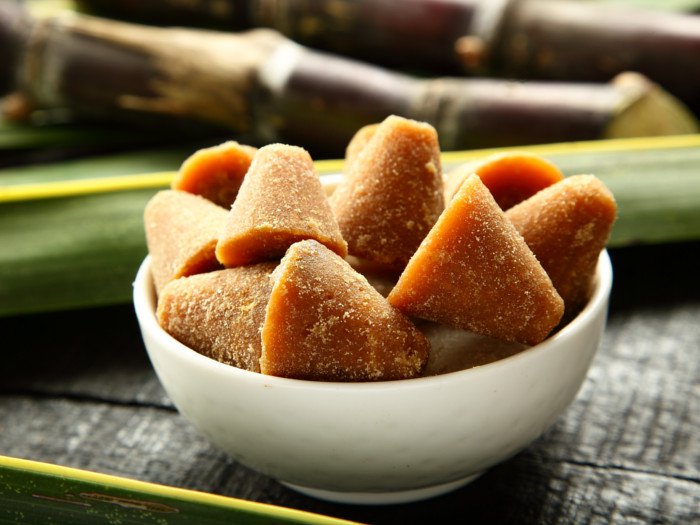
If you’re a fan of the flavor of molasses or caramel, you’ll love jaggery, a staple of South Asian cooking. Photo Credit: Shutterstock
Palmyra Jaggery
Color: Off-white to pale yellowish white.
Preparation: It is prepared by boiling the sap of Palmyra palm.
Physical state: Amorphous solid.
Place of availability: India (West Bengal) and Bangladesh.
Taste: Very sweet, with the typical aroma of Palmyra sap, somewhat like white chocolate.
Toddy Palm Jaggery
Color: Golden Brown.
Preparation: It is prepared by boiling the sap of Toddy’s palm.
Physical state: Amorphous solid.
Place of availability: Myanmar.
Taste: Very sweet, with the typical aroma of Toddy palm sap.
Other Palm Jaggery
These days, even the sap of Sago palm and Coconut palm are being used to make jaggery. The process of preparation remains the same, that is, the sap is boiled to a concentrated form until it attains an amorphous, solid form. The color ranges from golden yellow to golden brown to brown, depending upon the extent of boiling and the sugar content of the sap. Jaggery from these palms is made in Malaysia, Myanmar, and the Philippines.
Uses of Jaggery
Apart from being used in households as a sweetener and a flavoring agent, it may also be used extensively in the food and beverage industry. It is used in chocolates, candies, sorbets, traditional Indian health tonics, syrups, and for making alcoholic beverages, particularly rum. It has other industrial applications too.
Health Benefits of Jaggery
Jaggery of any type is better for health than refined white sugar. Its health benefits are explained in greater detail below.
May Have High Fiber and Mineral Content
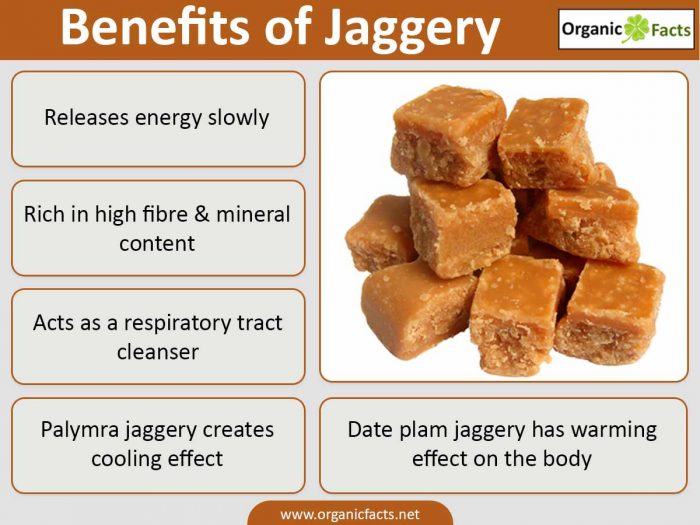
It may be rich in minerals, salts, vitamins and even contains some fiber, while sugar, being highly refined, lacks these nutrients. The darker the color, the richer it is in mineral content (particularly iron content) and the better it is for your health. [2]
May Be A Good Sugar Substitute
It may be much more complex than refined sugar and therefore may not increase the sugar level in the blood very quickly. It might provide energy slowly, over a longer period. Although diabetics should avoid jaggery, it is better than using sugar.
May Act As A Respiratory Tract Cleanser
For centuries on the Indian Subcontinent, sugar cane jaggery may have been used as a lung, throat, and respiratory tract cleanser as well as an additive to the local remedies for coughs and colds. Regular intake is particularly recommended for those who work in kilns, cement factories, stone crushers, dusty workplaces, furnaces and those who have to do a lot of driving, due to the effect that these professions can have on the respiratory system.
May Have A Cooling Effect
Palmyra jaggery, usually made into a drink by dissolving in water, might have a remarkable cooling effect on the body during summer. Perhaps that is the reason why Palmyra sap is harvested and jaggery is made only during summer.
May Have A Warming Effect
Date palm jaggery may also be manufactured and consumed in winter. It has a warming effect on the body and is nutritious as well.
Jaggery – Cultural Aspects
Jaggery, made from sugar cane juice or palm sap, reserves a distinct place in Indian culture and is used in many religious activities, rituals, and customs. Sugar cane jaggery is considered sacred and is consumed before the commencement of a new venture, journey, or business endeavor. It is customarily consumed after childbirth, after attending a funeral, and to celebrate any good news. [3]
It is an integral part of almost all harvest festivals celebrated in India. In Southern India, rice is cooked in sugar cane jaggery to make a dish offered to the gods after the harvest. Similarly, in western and northern India, sweet dishes are made from sugar cane jaggery and newly harvested crops like sesame, groundnuts, rice, and wheat flour to celebrate the harvest. In Eastern India, fabulously tasty sweet dishes like rice cakes, rice puddings, porridge, milk, and coconut sweets are made using rice flour, milk, coconut shredding and date palm jaggery. In that region, date palm jaggery is also considered a sacred offering to deities.
How Much Jaggery Should You Eat in a Day?
When consumed in moderation, it can do great things for our health. Nutritionists recommend having no more than 10 grams of jaggery every day.
How is Jaggery Made?
Jaggery is manufactured using two different processes. One is a manual process and the other is through automated plants. The majority of manufacturing may happen through the manual process.
Manual Manufacturing
In India and neighboring countries, it is made predominantly in rural areas by farmers. Although automated mills have been invented, manual jaggery manufacturing still remains the most widely used and most favored method of jaggery manufacturing.
- First, sugar cane is crushed and the juice is extracted from it.
- The sugar cane juice is then poured into a large, shallow, cast-iron vessel.
- It is continuously stirred using large ladles to avoid sticking to the bottom of the vessel.
- This boiling and stirring go on for hours until most of the water from the juice has evaporated and it starts to thicken. Slowly, it assumes the form of a thick, golden to a golden brown paste.
- The thick paste is then poured into various molds.
- On further condensation, the jaggery solidifies and is taken out of the molds, wrapped in paper and packed in jute or plastic bags.
- Thereafter, local agents or businessmen collect it from farmers and sell it in local markets. This is why you rarely see a company tag on any jaggery sold in India.
Some manufacturers may add baking soda or the juice of okra to improve the color, and a local herb known as veranda to give the jaggery a granular texture. The process for manufacturing Date palm and Palmyra varieties remains the same. [4]
There has been little improvement made in the traditional manufacturing process to enhance productivity. However, some work is now being carried out at the Sugarcane and Jaggery Research Center in Kolhapur, TIDE in Bangalore, and IIT Bombay.
Manufacturing by Automated Plants
This method of manufacturing is still in its infancy and is being used in very few countries. In this process, you pour in sugar cane juice from one end, set the plant at the required temperature and time, and wait for the jaggery blocks to come out from the other end. The best advantage of using an automated plant is that you get uniformly processed jaggery, of the same color and taste, in uniformly packed quantities. This method is used only for sugar cane jaggery.
Crisis for Jaggery Manufacturers
Date palm and Palmyra jaggery production in India has reduced drastically over the past decade. The reasons being that these palms are getting older, they are being cut down for construction, and there is a lack of planting new palms. Another reason is that this business was never an organized industry. While a handful of farmer families are still making it, the new generation is not interested in pursuing this business as they see no future in it.
Adulterations in Jaggery
Not all jaggery is adulterated, but there may be certain manufacturers who let greed prevail over the quality of their products. There are different types of adulterations for different types of jaggery, and some of them are explained below.
Adulterations in Sugar Cane Jaggery
The following adulterations have been detected in samples of sugar cane jaggery.
Sodium Bicarbonate (Baking soda): Some people might not consider this an adulteration, they might even say that it is a requirement of the process in some cases. Still, baking soda is most commonly used in the preparation of sugar cane jaggery to improve its color. It may not have any adverse effect on health. This can be judged by the color. The darker varieties are less likely to have this, while the light-colored ones are most likely.
ZFS (Zinc formaldehyde sulphoxylate): Commonly used in the textile industry, this harmful chemical may be used to improve its color. The darker the jaggery, the better the quality. However, the common belief is that lighter jaggery is good and hence some manufacturers may add these harmful chemicals to lighten it.
Sodium Hydrophosphide: This is another harmful chemical that may be used in jaggery to give it a brighter color.
Calcium carbonate (CaCO3) or Lime: This may be added to improve color, as well as to add weight since lime is far cheaper than jaggery. This can also be judged by the color (it should be light), hardness (should be very hard) and by the taste (if you have eaten the unadulterated form, you can detect this).
Although sometimes adding lime to sugarcane may not be for adulteration as the lime that is used in jaggery is derived from organic mollusk shells of clam. It is used as hardener during gur production.
Jaggery makes for a tasty sugar substitute. Photo Credit: Shutterstock
Adulteration in Date Palm Jaggery
This variety is commonly adulterated with the following.
Sugar Cane Jaggery: It is much cheaper than Date Palm Jaggery. So, the reason is obvious. It can be detected by the hardness (original unadulterated date palm jaggery is very soft and melts even at room temperature, while adulterated one should be much harder) and by the taste (it lacks the typical aroma and taste of unadulterated date palm jaggery). Sometimes, simple sugar cane jaggery blocks may be coated with date palm jaggery to fool the customers. Therefore, see what is inside before you buy.
Plain sugar: Again, the reason for this use is the same as above; sugar is cheaper. It makes the jaggery harder.
Adulteration in Palmyra Jaggery
This variety is adulterated with the following.
Sugar: Palmyra jaggery, being the most expensive of all types available in India, may most commonly be adulterated with plain sugar. This can easily be detected by the hardness (same test as that of date palm jaggery adulterated with sugar cane jaggery). Sometimes, sugar crystals may also be seen embedded in the blocks when scrutinized carefully. Again, when adulterated with sugar it may be much whiter than the unadulterated one, which is pale yellow in color. So, be sure to check well.
Sodium bicarbonate (Baking soda): This is added to give the jaggery a whiter look.
Yellow color: This color is often added when the jaggery contains excessive sugar contained in it and looks very white. This may be harmful to the health as no edible colors are used in these cases.
So go ahead and enjoy traditional jaggery as a sugar substitute in your tea or in your desserts, but make sure you use unadulterated varieties.