Until the standards for organic body care products are fully developed and implemented in all countries, as an informed consumer, you must check the ingredients of organic cosmetic products. To make informed decisions about the products you buy, you need detailed information about the different chemicals that are being used in cosmetic production and the organic alternatives for them.
Standards for Organic Body Care Products
The National Association for Sustainable Agriculture Australia (NASAA) is a renowned organization for certifying organic products in Australia. NASAA released a draft for health and beauty care standards. The standards are applicable for organic personal care products including herbal, toiletries, body care products, and cosmetics. [1] [2]
NASAA has provided the following broad guidelines for manufacturers who wish to label their cosmetic products as organic:
-The raw materials used in making organic body care products should be certified as organic.
-The processing should be minimal and should ensure that the natural properties of the raw materials are maintained. Many cosmetic products contain natural oils, such as essential oils that can lose their properties when subjected to severe temperatures.

It is best to take time to choose body care products, according to your skin type. Photo Credit: Shutterstock
-The products should be effective and superior in quality.
-There should be minimum pollution and environmental damage in the manufacturing and disposal of the products.
-The manufacturers should also properly label the products and provide accurate information to the consumers.
-There should be no harm caused to animals in the form of testing or procurement of raw materials.
-The association has also provided detailed guidelines for using raw materials, both agricultural as well as non-agricultural. The raw materials should not lose their natural properties after extraction and processing.
The Organic Consumers Association suggests that whenever you buy organic cosmetics, you should screen the truly organic products by examining the following conditions: [3]
- The cleansing and conditioning ingredients should be made from certified organic materials.
- They should not contain any chemical, synthetic, or petroleum derivatives.
- The manufacturing process should be simple and ecological in nature.
- Non-agricultural water such as floral water and botanical water extracts should not be used to increase the percentage of organic content in the product.
List of Ingredients to Look For
The Sacramento Natural Foods Co-op, educates consumers about controversial ingredients that can be used in organic personal care products in its guide ‘Body Care – A Consumer’s Guide to Shopping and Living Green’. The following reference list can help you in judging organic cosmetics: [4] [5]
Emollients
Emollients are added to numerous body care products, especially those meant for skin care, because these substances help in moisturizing the body surface.
Chemical petroleum-based emollients include hydrogenated oils, butyl glycol, mineral oil, monostearate dimethicone, oleth 2, paraffin, stearic acid, petrolatum, potassium stearate, and octyl palmitate.
Natural oils and waxes that you should look for as emolliating agents include almond oil, beeswax, coconut oil, cocoa butter, jojoba oil, shea butter, and olive oil.
You can also use certain natural oils with caution. These include cottonseed oil (cotton is often grown with pesticides and about 25% of the global pesticides and insecticides are used in cotton farming), peanut oil (it can cause allergic reactions on the skin, so do not use products containing peanut oil if your are allergic to peanuts), and grapeseed oil (check the means of extracting the oil as solvent extraction is the most preferred way of extracting the oil).
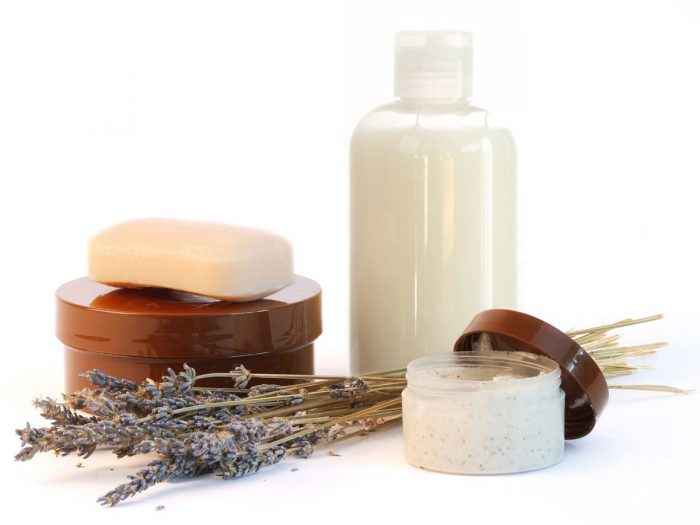
Body care can include keeping proper hygiene and taking care of your skin and body. Photo Credit: Shutterstock
Preservatives
Preservatives are added not only in food products, but also in cosmetic products, since these are also susceptible to bacterial growth. Avoid any cosmetic products with an excessive amount of preservatives.
Chemical or petroleum-based preservatives include butyl paraben, methyl paraben, ethyl paraben, propyl paraben, and dazolidinyl urea.
Natural preservatives include essential oils, vinegar, grain alcohol, honey, vitamins A, C, and E, as well as grapefruit seed extract (GSE).
Fragrances
There are hardly any cosmetic products on the market that do not have an aroma. Organic essential oils are the most important sources of organic fragrance additives.
Synthetic fragrances include amyl acetate (banana scent), benzophenone (rose scent), coconut fragrance, cucumber fragrance, and various fruit fragrances. Consistent research in the field of chemical fragrances has enabled companies to develop synthetics that smell exactly like the natural products and if you don’t read the contents properly, you can easily mistake them for natural fragrances.
Organic plant extracts that have strong fragrances include extracts from cedarwood, lemongrass, citronella, orange, eucalyptus, tea tree, and fennel. Organic essential oils are so effective that they form the basis of aromatherapy, which has been practiced in ancient civilizations for thousands of years and is now gaining rapidly in popularity.
Solvents
Solvents form an essential part of all body care products. Solvents dissolve one or more substances, which is why you get a uniform solution, cream, or gel.
Common synthetic or chemical solvents used in personal care products include acetone, propylene glycol, benzene, butylene glycol, and hexane.
Water is the most efficient solvent, as it is neutral in nature. Water is added in many cosmetic products in varying proportions.
Other natural solvents include apple cider vinegar and grain alcohol.
Colorants
Since cosmetic products are primarily used for looks, the appearance of these products is also important. Colorants are therefore added to body care creams, lotions, and gels to ensure that consumers don’t reject them due to a dull color. Be very wary of this.
Synthetic colors are obtained from coal tar.